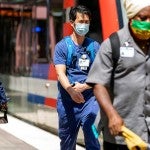
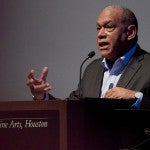
Tamika L. Butler loves biking, transit and transportation, and she advocates for all three because she cares about her family and wants to build a better world for them. That’s why, when talking about transportation, planning and the built environment — especially now, when transit agencies are considering drastic cuts because of the pandemic — she always talks about race.
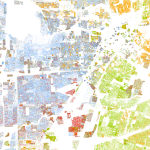
In the time since the Immigration and Nationality Act was signed in 1965, the demographics of Houston have changed dramatically. In 1980, the city was 55% white, 28% Black and 17% Hispanic. Today, the population is 25% white, 22% Black, around 7% Asian and nearly 45% Hispanic. Despite Houston’s high level of diversity, the city’s neighborhoods are segregated to a large degree.
Contrary to popular opinion, efforts to integrate schools in the 1970s and 1980s were overwhelmingly successful, says economist Rucker C. Johnson. Johnson argues that we must renew our commitment to integration for the sake of all Americans.
In many places, the public library often functions as a community center — a free and shared space that provides crucial social infrastructure for neighborhoods. That’s especially true when a disaster such as Hurricane Harvey hits. But what happens when a crisis like COVID-19 keeps libraries closed for five months and counting.
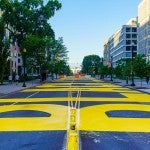
Washington, D.C. Mayor Muriel Bowser ordered “BLACK LIVES MATTER” to be painted on a street near the White House. The act would have been considered vandalism had it not been done by city workers.
When colleges and universities moved to online classes in response to the coronavirus pandemic, student fellows in the Kinder Institute’s Community Bridges program pivoted as well, turning their focus to the relationship between COVID-19 and inequality.
The COVID-19 crisis forced many companies to quickly transition to work from home. Now, as the economy continues to open up, businesses have to decide if they’ll go back to the onsite world of the old normal or continue with the remote-work model of the new normal. Employees of companies that choose the latter will have more options for where they live and office, including the Urban Hotel, the Suburban Workshop and the Exurban Metropolis.
Public art is an important part of urban design that strengthens community identity and pride. It can have cultural and economic benefits for neighborhoods and it’s accessible to everyone. Great and unexpected pieces of public art can be found across Houston. And best of all, it can be enjoyed at a safe distance from others.
New York City Parks Commissioner Mitchell J. Silver discussed how innovative projects have transformed many of the city’s parks as well the lives of residents.
If the Trust for Public Land’s annual ParkScore rankings mean anything to you, Houston’s steady slide over the past seven years may surprise, concern, frustrate or alarm you. The nonprofit’s evaluation of “park access and quality” — based on an assessment of access, investment, acreage and amenities — puts Houston at No. 85 among the nation’s 100 largest cities. Overall, the city’s parks get a score of 35.3.
The Acres Homes Health Action Team is contending with food insecurity, health disparities and climate change and more. It’s also excited and passionate about the Acres Homes community and making it stronger.
Bus rapid transit — BRT for short — is part of METRO’s plan for improving public transportation in the Houston area. It will feaure 75 miles of MetroRapid service on dedicated, bus-only lanes. Here’s a breakdown of BRT.
This is a part of a series connected to our partnership with the Greater Houston Community Foundation's regional project Understanding Houston. This story, and others in the series, also appears on the Understanding Houston website.