In the three decades since Martha Wong’s trailblazing ascent to a Houston City Council seat, Houston-area Asian leaders have steadily gained representation in the local political arena.
Asian residents now hold three seats in the Texas House of Representatives, serve as the Fort Bend County judge and mayors of Missouri City, Piney Point Village and Stafford, and occupy spots on several local councils and school boards.
To reach this point, Houston’s Asian elected officials have navigated unique challenges in appealing to the region’s ethnically and politically diverse Asian communities, let alone voters of other backgrounds.
This post is part of a series exploring the findings and implications of the Asian American Community Study, a multiyear initiative exploring the diverse experiences, attitudes and beliefs of this dynamic and fast-growing population group in the Houston region.
A new Kinder Institute survey of about 2,100 Houston-area Asian residents, conducted as part of a multiyear research effort into the fast-growing population, found they are almost evenly split between conservatives, liberals and moderates — a distribution that roughly reflects the region as a whole.
At the same time, political attitudes can diverge based on ethnicity, age and other factors, forcing politicians to navigate the nuances of Houston’s distinctive Asian groups.
In recent weeks, Urban Edge spoke with three elected officials — Sugar Land City Councilmember Sanjay Singhal, Alief ISD Trustee Lily Truong and former Houston City Councilmember Gordon Quan — about their experiences running for office and serving local residents. They described the delicate work of coalition building, finding common ground on local issues and balancing an emphasis on their heritage with the demands of a diverse city.
Bridging partisan divides in Sugar Land
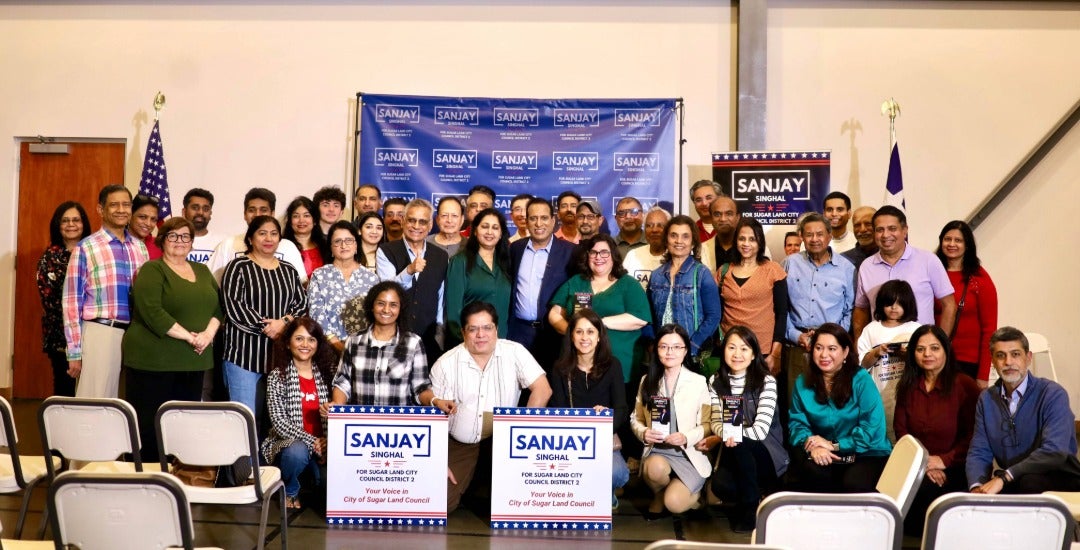
When Singhal, an energy executive, retired after three-plus decades working for Schlumberger, public service called. The Sugar Land resident and homeowners association president believed his city council wasn’t responsive enough to the community’s desires, particularly when it came to development and construction of a gas-fired power plant.
So Singhal, who had never voted in a partisan primary or sought political office, ran for a city council seat in 2025.
While Sugar Land City Council races are nonpartisan, candidates sometimes prioritize partisan affiliations or hot-button national issues. Singhal, however, ran as an independent focused on local issues: lowering taxes, making government operations more efficient, opposing dense development that conflicted with Sugar Land’s suburban character and fighting the proposed power plant.
The approach helped Singhal bridge gaps between parties and generations, particularly in Sugar Land’s large Asian community. Older Asian Americans often lean Republican, valuing security and lower taxes, while the younger generation is more liberal and environmentally conscious, he said.
“People aren’t focusing as much on abortion rights or gun control at the local level,” Singhal said. “I benefited from being independent and keeping the race focused locally.”
Singhal, an Asian Indian American, said his messaging didn’t change much depending on his audience, though he varied it slightly when talking to Asian voters. He emphasized the lack of Asian American representation in government relative to the local population size. He also reinforced the importance of voting to Asian residents — particularly those of Asian Indian and Chinese ethnicity — after seeing they had below-average turnout rates in municipal elections.
“My pitch was that unless you vote — regardless of who you vote for — you will not be taken seriously,” Singhal said.
Singhal won nearly 40% of the vote in a five-candidate general election, then cruised to 75% of the vote in a runoff.
“Being from an Indo-American and Asian American background, I had support from that community,” Singhal said. “But I also received significant support from White and other communities because I ran on issues people could identify with.”
Building alliances in Alief
For Truong, an Alief ISD trustee, shared experiences help her easily bond with the district’s large number of Latino and Black families.
She understands the challenges of immigrant life after fleeing Vietnam in the 1970s. She grew up in poverty in Alief, where the median household income today barely cracks $50,000. And she had a drive to succeed through education, graduating from Alief Hastings High School and earning degrees from the University of Houston and Texas Chiropractic College.
Those commonalities have shaped Truong’s approach to winning public office and serving the west Houston community. She said she looks beyond her own demographic — Asian students make up just 10% of the district, while Hispanic students account for 63% and Black students are 23% — and appeals to all populations. It’s a philosophy rooted in her core belief that every student deserves the same opportunities.
“Honestly, I don't cater only to Asian Americans. I cater to all the students because, to me, they all need help,” Truong said. “I know that Asian students are often really into education. I focus a lot more on the Hispanic and African American students because a lot of them are the first in their families to graduate or go to college.”
Truong, an educational consultant and former English as a Second Language teacher, won her first trustee race in 2015 and has since been reelected twice. She said she doesn’t emphasize her ethnicity while in office, instead prioritizing parent concerns like education quality, student safety and cellphone usage in schools.
“I don't want cases where I’m ‘Asian only,’” Truong said. “With my background, having to learn from other immigrants is what helps me.”
For Truong, focusing on issues like education and safety is more important than ethnic or partisan divides — a mindset she has passed down to her children. While Truong believes younger Asian Americans are more politically active than she was at their age, she emphasized participation over party loyalty.
“Asian Americans are Americans. Period,” Truong said. “Your vote is important. It doesn't matter who you vote for, but you need to go out and do your duty.”
How former Houston councilman broadened his appeal
When Quan began plotting his 1999 Houston City Council campaign, he told a key adviser he wanted to center his message on Asian American contributions to the city. The consultant delivered a blunt response: His identity as a Chinese American already sent that message.
Instead, Quan was encouraged to focus on “the conservative White guy in the back of the room” wondering what Quan’s candidacy offered him.
“I thought, 'Boy, that's a really different way to look at this,'” Quan said. "They said, 'You're not running for Asian Americans. You're running for the whole city, and your message has to be one that resonates with everybody.'"
Quan, a native of Houston’s East End and a graduate of Milby High School, followed the advice. To prove his local bona fides, his campaign ran a TV spot that parodied popular Pace Picante Sauce commercials at the time, which riffed on its authentic Texas roots. The ad featured a narrator with a thick Southern drawl that described Quan’s background and declared, "Gordon Quan: He’s one of us."
“I emphasized that I spoke English with no accent,” Quan said. “I wasn't a foreigner, but a member of this community. At the end of the commercial, there were multiethnic children walking toward the Houston skyline. The subtle message was: This is Houston's future.”
Quan found that campaigning as a Houstonian first did not require him to downplay his heritage once he was elected.
While he prioritized citywide issues like senior services and public safety, Quan leveraged his platform to address public safety concerns for the Asian American community. He proposed creating “safety zones” where Asian business owners targeted by crime would not have their immigration status investigated.
Since leaving City Hall in 2006, Quan has remained focused on the region's political landscape. He advises Asian American political hopefuls to build bonds and allies across ethnic, party and racial lines.
“Don't just show up when you want to seek office,” Quan said. “Have a history that you're already committed to these communities before you run."