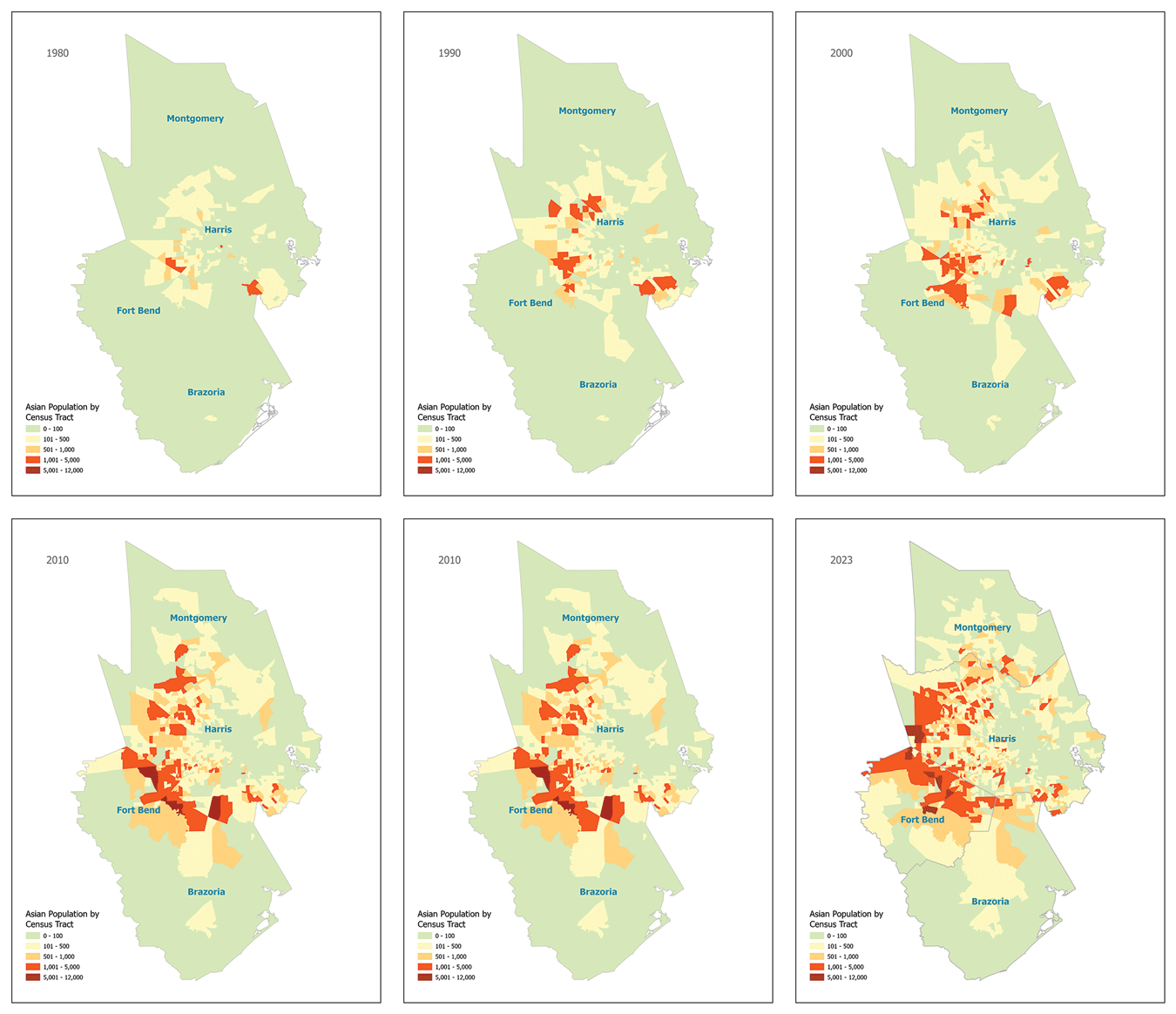
At the dawn of the 1980s, with the Bayou City standing on the precipice of explosive growth, Asian residents were out of sight of most Houstonians. The region’s roughly 50,000 Asian inhabitants, totaling just 2% of the local population, largely clustered in two sections on the outer edges of Harris County.
In the 45 years since, much has changed.
A confluence of domestic and international forces — globalization, the fall of Saigon and relaxed immigration policies, among others — drew Asian immigrants to Houston. Second and third generations rose behind relatives who crossed the Pacific or migrated from coastal American hubs. And the promise of prosperity, fueled by financial opportunity and affordable living, led many to lay down roots.
This post is part of a series exploring the findings and implications of the Asian American Community Study, a multiyear initiative exploring the diverse experiences, attitudes and beliefs of this dynamic and fast-growing population group in the Houston region.
Today, Houston’s 655,000 Asian residents are an economic, cultural and political cornerstone of Houston, comprising 9% of the region and residing in virtually all corners of the metro area.
To better understand Houston’s diverse, rapidly growing Asian community, the Kinder Institute for Urban Research is in the midst of a multiyear research and survey effort examining this multiethnic population. The first of several reports, most of which were published Monday, document several decades of population patterns fueling the emergence of Asians in Harris, Fort Bend, Montgomery and Brazoria counties.
Census data analyzed by researchers illustrates how Asians of numerous ethnicities gradually settled in Houston, established communities and nurtured families in Texas’ largest city.
“Houston’s growth isn’t just about population size. It’s about who is arriving here, where they’re settling down, how their lives are shaped by Houston and how they are shaping Houston,” said Katharine Bao, a Kinder Institute research scientist and co-author of the study. “I hope this helps the public move beyond the idea of Asians as a monolithic group and recognize the fullness and richness of their significance to Houston.”
A multiethnic movement
Houston’s diversity ranks among the region’s most defining traits of the past 45 years — and Asian residents played a major role in the shift.
While the population size of all races and ethnicities increased over the decades, Asian residents have steadily increased their share alongside Latino and, to a lesser extent, Black Houstonians. White residents, meanwhile, have become a smaller share of the region.
Several ethnicities have propelled the rise of Houston’s Asian population.
Asian Indians, who ranked third in population in 1980, now comprise the largest share of Asians in the four-county region. Many Asian Indians were drawn to high-skill positions in Houston’s energy, medical and academic institutions, illustrated by 70% of current residents holding a bachelor’s or higher degree.
Vietnamese ranks a close second, with much of the growth stemming from refugees arriving after the Vietnam War and establishing families in the area. Roughly one-third of local Vietnamese residents are second-generation, the highest share among the most prominent Asian ethnicities in Houston.
Chinese and Taiwanese residents make up the third-largest Asian ethnicity in Houston. They’re followed in order by Filipino, Pakistani, Korean and Japanese residents.
Houston’s Asian population largely derives from immigrants who first settled in Houston or moved to the area after initially residing in other U.S. cities.
In a Kinder Institute survey of 2,100 Asian residents in the four-county area, about two-thirds identified as first-generation, meaning they were born outside of the U.S. and subsequently moved here. One-quarter of respondents identified as second-generation, defined as having at least one foreign-born parent.
Calling Houston home
In 1980, most of Houston’s Asian population resided in a pair of areas near Harris County’s southern border. The highest concentration of residents called Alief and the surrounding neighborhoods home, while another group settled near Clear Lake and Webster.
Those parts of Houston remain prominent spots for Asian residents, but they’re hardly alone.
Today, swaths of western Harris and northern Fort Bend counties — including parts of Cypress, Katy, Sugar Land and Richmond — are home to tens of thousands of Asian residents.
Meanwhile, areas of Houston that had virtually no Asian presence decades ago are now home to thousands of residents. They include Humble, Spring, parts of Pearland and neighborhoods near NRG Stadium.
While Houston is known for Asian enclaves like Chinatown, Little Saigon and the Mahatma Gandhi District, the region stands out for its diversity even at the neighborhood level. In areas with the highest concentration of Asian residents, one ethnicity often does not constitute a majority of the population.
Bao said the ethnic and geographic data about Houston’s diverse Asian communities can help dispel myths and shed light on the needs of often-overlooked residents.
“As a member of the Asian community and a researcher, I’ve seen firsthand how Asian communities are often invisible in local data or lumped together into one simple story,” Bao said.
“For us to thrive as we continue to grow, it’s really important to understand these communities not just as a demographic group, but as an active contributor to the social, economic and cultural fabric of Houston, each with their own varied experiences, needs and aspirations.