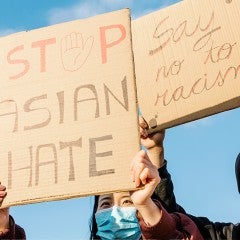
For Jen, a Korean American living in the Houston area, anti-Asian bias is a continuing reality at her workplace, the grocery store and other everyday settings.
Strangers have told her to “go back to my country,” even though she was born in the United States. Others have made incorrect assumptions about her ethnicity and nationality. And she’s heard people mock Asian languages and make prejudicial statements, such as blaming Asian immigrants for the COVID-19 pandemic.
“Some still see the Asian American community as just one monolithic, homogeneous community of people who look alike and have the same language,” Jen, 53, said in an interview. “Not understanding that diversity also emphasizes how much of an ‘other’ we still are.”
This post is part of a series exploring the findings and implications of the Asian American Community Study, a multiyear initiative exploring the diverse experiences, attitudes and beliefs of this dynamic and fast-growing population group in the Houston region.
Jen’s experiences reflect a wider regional pattern documented in the Kinder Institute’s Asian American Community Study, a multiyear research effort dedicated to understanding the region’s Asian population.
Jen was one of nearly 40% of Asian residents who said they, a family member or a friend had experienced discrimination in the past year because of their ethnicity. The survey was conducted between November 2024 and February 2025 with about 2,100 adults living in Brazoria, Fort Bend, Harris and Montgomery counties.
The results illustrate the frequency and breadth of discrimination faced by the region’s 650,000-plus Asian residents, who account for nearly 10% of the local population. Respondents reported a wide range of types, locations and perpetrators of discrimination, with only moderate differences between ethnicities.
The Kinder Institute survey marks the most in-depth examination of Asian Americans’ experiences with discrimination in Houston to date. While the region is well-known for its diversity and embrace of multiculturalism, the responses suggest Asian Americans’ experiences in Houston aren’t dramatically different from others across the nation.
In 2025, more than one-third of Asian Americans said they were “often” or “sometimes” discriminated against because of their race or ethnicity when applying for jobs or in stores, according to a survey by AAPI Data and the Associated Press-NORC Center for Public Affairs Research.
In a Pew Research Center poll published in 2023, slightly more than half of 7,000 Asian Americans surveyed said they had been discriminated against “from time to time,” while another 5% said they experienced “regular” discrimination.
“We know Houston to be a welcoming place, but the region isn’t immune to incidents of anti-Asian bias,” said Dan Potter, director of the Kinder Institute’s Houston Population Research Center and co-author of the study.
“Education and self-awareness can help prevent these everyday incidents, but we are also up against heated political rhetoric. That language can trickle down and reinforce anti-Asian bias. Leaders need to ensure their words and policies are fixing the problem, not adding to it.”
Inside the data
In responses to the Kinder Institute survey, about 370 Asian residents in Houston detailed their personal experiences with discrimination.
Nearly half of them cited insults and derogatory comments. Nearly one-quarter reported differential or exclusionary treatment, while about one-fifth said people had questioned whether they belonged in the United States.
Of those who detailed where the incidents took place, most pointed to everyday environments. Stores were most frequently cited, followed closely by workplaces and general public spaces. Neighborhoods, schools and service offices also were noted.
When researchers asked respondents who personally experienced discrimination about the identity of the perpetrators, 56% said they were strangers, while 32% reported a combination of strangers and people they knew.
Rates of discrimination varied by ethnicity, with Asian residents of two-plus races or ethnicities most often reporting experiences with bias in the past year (53% of respondents) and Vietnamese residents least often reporting experiences (31% of respondents).
The data also reveals a contrast in how different age groups encounter discrimination across the Houston area. Young adults were four times more likely than adults 60 and older to report that they and their friends or family had been victims of discrimination in the past year. They were also nearly twice as likely to report experiences with anti-Asian sentiments or symbols.
Behind the bias
Stevie Vu, a community advocate and co-founder of the Chow Down Chinatown Facebook group, which countered misinformation and xenophobia against Houston’s Asian businesses during the COVID-19 pandemic, said cultural blind spots about Asian American history and experiences have endured for generations. Educational gaps, meanwhile, have allowed many stereotypes to linger.
Vu said he hopes to see Asian American history integrated more into social science classes alongside the experiences of African Americans, Latinos and Native Americans.
"Having Asian American historical contexts more visible alongside others could help disrupt the stereotypes that harm not only Asian Americans but also other people of color, and guide us into a more welcoming future," Vu said.
While everyday experiences of bias have long been a reality for many residents, the COVID-19 pandemic also shined a national and local spotlight on anti-Asian discrimination. In their study, Kinder Institute researchers wrote “the cultural and political changes produced by the pandemic fostered an environment that could intensify and shape these experiences.”
“Despite the progress that has been made in raising awareness since the COVID-19 pandemic, I believe many Asian Americans still experience discrimination in ways that are both overt and subtle,” Vu said. “Even if those comments may seem less visible today than during the height of the pandemic, they still occur in everyday settings such as public spaces, schools and work environments.”
For Jen, the frequency of discriminatory encounters points to what she believes is a broader issue of Asian Americans being stereotyped as affluent, leading to their struggles being frequently ignored by the public.
“One of the negative impacts is this whole model minority myth,” she said. “People think we don’t really have problems, or our issues aren’t a priority, because all they might see are the doctors and the Ph.D.s. That’s one way discrimination has really impacted us.”