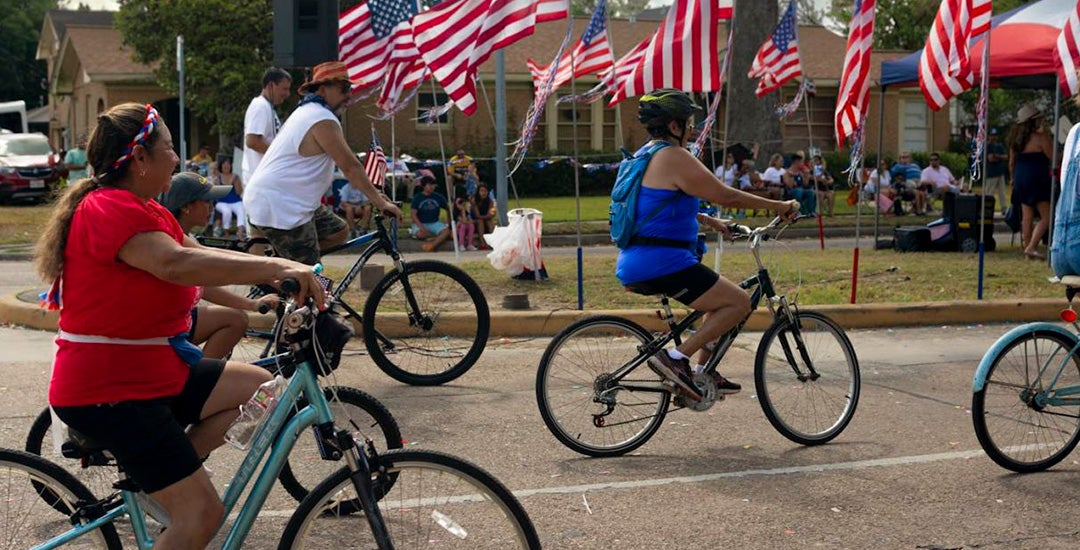
Good neighbors can do more than lend a cup of sugar. In Houston, they can make you healthier and happier.
A new Kinder Institute for Urban Research analysis has found a strong connection between neighborhood cohesion and Houston residents’ physical health, mental health and feelings of personal safety. The research, published last week in the 45th Kinder Houston Area Survey, adds to decades of evidence showing that social cohesion has wide-ranging benefits that often go unseen.
Concerns about mounting divisiveness led Kinder Institute researchers to prioritize the issue in the annual Kinder Houston Area Survey, which has polled thousands of local residents on their attitudes and experiences since the early 1980s. Communities across the country are grappling with a fraying social fabric torn apart by heightened political divisions, declining trust in institutions and a retreat into digital spaces, among numerous other developments.
To evaluate the scope and impact of social cohesion in Houston, researchers asked 8,800 respondents in Harris, Fort Bend and Montgomery counties to answer seven questions about the strength of relationships and values in their neighborhood. At the same time, the survey participants self-reported aspects of their health and perceptions of safety.
Using those results and controlling for other demographic variables, such as income level and geographic location of residence, researchers evaluated how strongly social cohesion predicted positive reports about health and safety.
The result: a clear, consistent link. Often, social cohesion had a larger impact on health and safety than demographic factors, including gender, race and ethnicity. By one measure, the health impact of moving from the 10th percentile to 90th percentile on the social cohesion index is greater than moving from a household income of less than $25,000 to more than $100,000.
“Social cohesion is a big, powerful predictor that might help explain some of the disparities and gaps we’re seeing in Houston,” said Dan Potter, co-director of the Kinder Institute’s Houston Population Research Center and lead author of the survey. “We think it’s important, but we don’t appreciate how important it is.”
Potter cautioned that the findings establish correlation, not causation, between social cohesion and health and safety.
Measuring cohesion in Houston
Nearly three decades ago, a trio of researchers published a landmark study that found tight-knit neighborhoods in Chicago populated by residents willing to act for the common good can reduce violence.
To measure neighborhood cohesion, they asked thousands of residents to rate how much they agree or disagree with five statements. For example: “people in this neighborhood can be trusted,” “this is a close-knit neighborhood,” and “people in this neighborhood do not share the same values.”
Earlier this year, Kinder Institute researchers presented those five statements and two others to members of the Greater Houston Community Panel, a scientifically selected group of adults regularly surveyed about their families and communities.
Based on their answers, researchers assigned each participant a social cohesion score ranging from 1 (very low) to 5 (very high). To ensure social cohesion metrics weren’t merely a proxy for income level or other factors, the researchers statistically controlled for several demographic variables.
A person scoring in the 10th percentile totaled about 2.5, an average respondent clocked in at about 3.5, and someone in the 90th percentile neared 4.5.
From there, researchers sought to link social cohesion scores with perceptions of health and safety.
With regard to physical health, a person in the 10th percentile of social cohesion had a 41% chance of reporting they were in “very good” or “excellent” condition, while a respondent in the 90th percentile had a 60% likelihood. A nearly identical gap emerged for mental health.
Similar trends emerged on matters of safety. A resident in the 10th percentile had a 55% predicted probability of reporting they “sometimes,” “often” or “almost always” felt unsafe in their day-to-day life. A respondent in the 90th percentile had a 37% chance. The gap slightly widened when connecting social cohesion to confidence in walking alone at night without fear of being attacked or harassed.
“We expected it to be related, but I think the magnitude of the impact is what caught us off guard time and time again,” Potter said. “In some cases, social cohesion was as much of a predictor, if not more, than income level or actual crime activity in a neighborhood.”
Potter said the Houston data points to potential positive and negative feedback loops. Residents in socially cohesive communities are more likely to be healthy and feel safe, which makes them more likely to interact with their neighbors, further boosting their well-being. The opposite, however, also holds true.
Building cohesive communities
The Houston findings generally align with about three decades of research into the positive effects of social cohesion.
Ichiro Kawachi, a professor of social epidemiology at the Harvard School of Public Health, said thousands of studies conducted across the world have largely validated that people living in more cohesive neighborhoods are healthier, exercise more and follow medical recommendations more closely. The impact has been particularly strong following natural disasters, the COVID-19 pandemic and other major disruptions that spur collective action.
Researchers and public leaders have identified strong examples of neighborhoods intentionally building social cohesion, though scalable solutions are difficult to find because success stories are often heavily dependent on local histories and conditions, Kawachi said.
“You can’t impose something from the top down,” Kawachi said. “You have to work with the community to understand what their challenges are. That kind of principle makes it very important for researchers to engage in a participatory way (with residents).”
While numerous community leaders are working to bolster social cohesion, Potter forecasted that extensive work will be needed to reverse the gradual loss of connectedness over time.
“We’ve spent decades as a society destroying mechanisms for social cohesion,” Potter said. “Churches are shrinking in size. Community centers are shrinking in importance. We don’t have as many intersecting spaces for people to come together. It’s going to take intentionality on the part of local leaders — businesses, nonprofits, politicians, community members — to make that happen again.”