Greater Houston is still growing at a healthy clip — even with birth rates flattening, domestic migration slowing and immigration policies changing.
But new population estimates published by the Census Bureau show several subtle shifts in where and how Houston’s population is evolving after years of unrelenting growth across the region.
The latest figures document metrowide and county-level population estimates as of July 2025, part of an annual publication known as the Vintage estimates. The Census Bureau uses birth, death and migration data from administrative sources to calculate its estimates, rather than counting residents like it does for the once-every-10-years census.
These five patterns particularly emerged from the Vintage 2025 data, potentially foretelling demographic changes that will impact local economies, development, schools and communities for decades to come.
Harris County keeps pace with Texas’ urban counterparts
Greater Houston added an estimated 126,720 people between mid-2024 and mid-2025, down from an increase of 190,261 in the prior year.
Harris County accounted for nearly 50,000 people, a 1% bump that trailed behind the growth rate of all other Houston-area counties. Migration from Harris County to the suburbs and other parts of the U.S. picked up, while international immigration slowed after record numbers arrived in 2023-24.
Still, Harris County’s population continues to climb at a rate on par with — and often faster than — other urban Texas counties facing similar population trends. Dallas and El Paso counties lost population during the prior year, while three other urban metro counties — Bexar, Tarrant and Travis — all saw their populations rise by 0.8% to 1.1%.
Zooming out to five-year trends, Harris County’s growth rate well outpaced Dallas and El Paso counties and was comparable to its other urban peers.
Houston’s suburbs once again drive the most change
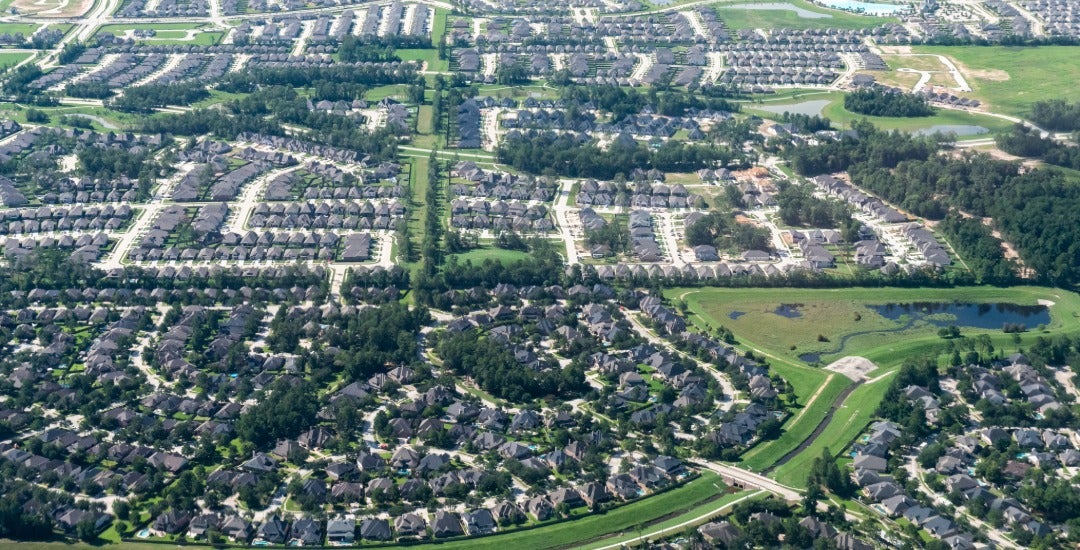
The lure of affordable housing, cheap land and suburban life continues to power growth outside of Harris County.
The nine other counties constituting the Houston metropolitan area — Austin, Brazoria, Chambers, Fort Bend, Galveston, Liberty, Montgomery, San Jacinto and Waller — totaled a net population increase of about 78,000, up 2.8% from the prior year.
While Harris County once accounted for the lion’s share of Houston’s growth, the suburbs have taken up the mantle over the past decade.
Domestic migration slips in Harris, slows in Fort Bend
About 43,400 fewer people moved into Harris County from other parts of the U.S. than left for other U.S. destinations. That’s the county’s highest net negative domestic migration figure since 2018.
Historically, Harris County has lost its largest share of residents to the nearby suburbs, followed by the Austin and Dallas areas, according to Census estimates. However, exact data is not available for the past few years.
While Fort Bend County continues to bring in more domestic residents than it loses, that growth has notably slowed over the past two years. Montgomery County, by comparison, has seen a steady inflow of domestic residents.
Waller County booms — with no signs of slowing down
Waller County has been one of the region’s fastest-growing areas, and the 2024-25 period marked a new high.
The western Houston county’s population jumped from about 66,100 to 69,900 in a single year, a 5.7% increase that blew past its previous record and ranked as the nation’s second-highest rate among counties with at least 20,000 people.
Large residential developers have descended on Waller County in recent years, while companies have established massive industrial spaces across its abundant land.
Liberty County’s growth slightly tapers off
On the northeast side of Houston, Liberty County’s population has skyrocketed largely due to the sprawling Colony Ridge residential development, hitting about 121,400. From mid-2020 to mid-2024, its head count rose by at least 5% annually.
Liberty County is still a boomtown in many ways — its population climbed another 4.4% from mid-2024 to mid-2025, the nation’s eighth-fastest rate — but the past year brought a modest slowdown.
The county’s growth could further taper off after Colony Ridge’s developers agreed in February to a three-year moratorium on seeking new residential plats as part of a legal settlement tied to allegations of predatory advertising and lending.