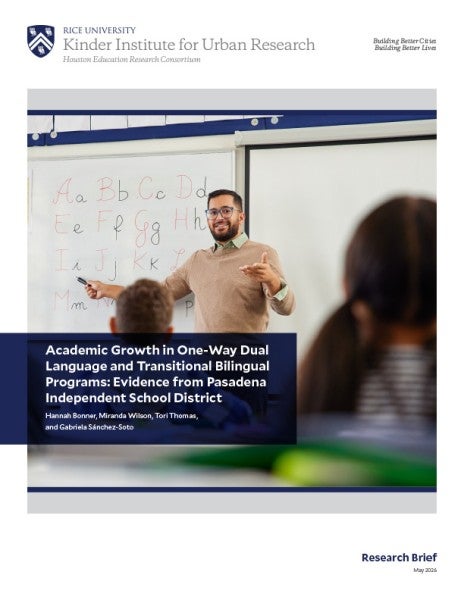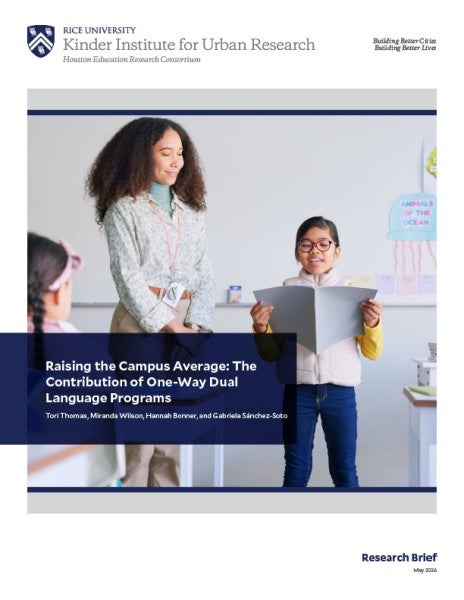
Young emergent bilingual students perform better academically when they learn in both English and in their home language, which boosts campus achievement overall.
In Pasadena ISD, where 35% of students are emergent bilingual (EB), the district has phased out transitional bilingual (TB) programs in favor of one-way dual language (OWDL) programs. While TB focuses on shifting to English-only instruction, OWDL emphasizes long-term bilingualism and biliteracy.
To better understand how EB students perform under different teaching approaches, this study compares the academic outcomes of Pasadena ISD’s TB, OWDL and English-only cohorts from first through second grade. Insights will help guide future decisions for Pasadena ISD and other districts considering similar changes to their EB programs.
Key findings
- OWDL students outperformed their TB peers in reading and math and showed greater growth in academic readiness, reinforcing existing research that dual language programs drive higher achievement in the long term.
- TB students scored higher in second-grade English proficiency. This was expected, as TB focuses on faster English development. Prior research suggests gaps diminish over time.
- By matching or outperforming their English-only peers, OWDL students made a positive contribution to overall campus performance, bolstering accountability ratings and public perception of school quality.
- Achievement gaps between OWDL students and English-only students were largely driven by kindergarten readiness and home-language use. OWDL students often enter school with stronger readiness skills — potentially due to better access to foundational programs like prekindergarten.
Recommendations
The study suggests that OWDL programs effectively support EB students. Notably, a slower start in English proficiency does not hinder academic success.
To increase program impact, districts should:
- Leverage home language as an asset, expanding language-affirming practices beyond OWDL classrooms
- Monitor long-term student composition and placement to determine whether success is driven by instructional quality or changing student demographics
- Proactively communicate the benefits of OWDL and evaluate whether program access is equitable to prevent selective enrollment patterns