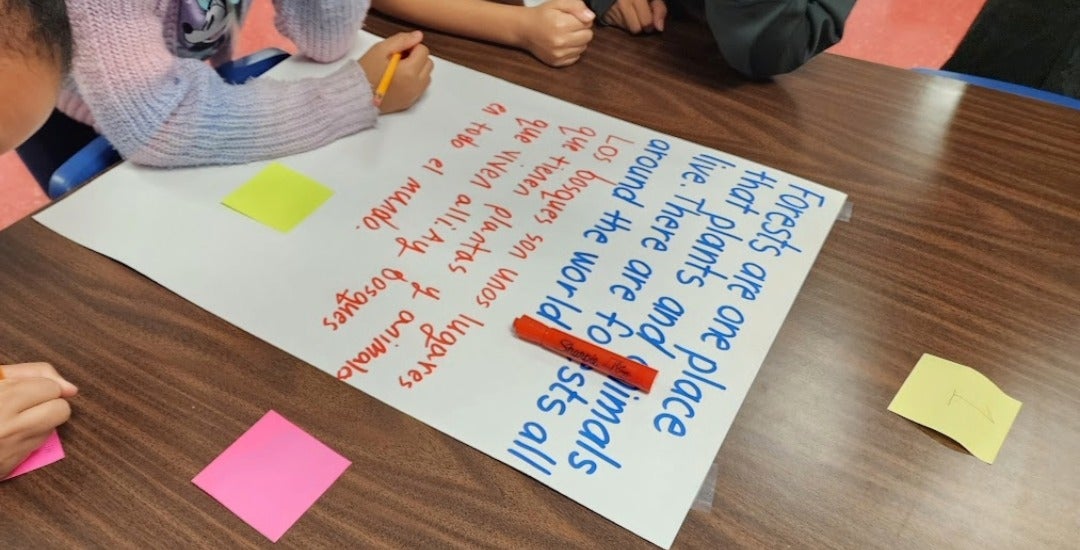
For emergent bilingual students, a little more time speaking their native language in elementary school could have big benefits later in life.
A new report by the Kinder Institute’s Houston Education Research Consortium shows emergent bilingual second-graders in Pasadena Independent School District made greater academic progress under a newer classroom initiative, known as One-Way Dual Language, that features more instruction in Spanish.
The results, released Monday, echo previous studies finding a slower-but-steadier approach to introducing English-language instruction in elementary schools can have a positive long-term impact on emergent bilingual children, who often speak a different language at home.
In Pasadena, second-graders in the district’s One-Way Dual Language program scored 4 percentile points higher on standardized math and reading tests in 2025 than students in Transitional Bilingual classes, which place more emphasis on rapid English-language acquisition. One-Way Dual Language students also scored 2 percentile points higher on an assessment measuring grade-level readiness.
The Kinder Institute’s analysis controlled for students’ demographic characteristics and past academic performance.
“As a researcher, I was very impressed,” said Kinder Institute senior researcher Gabriela Sánchez-Soto, a co-author of the report. “Educational research rarely gives you huge changes. It’s usually very incremental, very slow change. So for us to already be able to detect that positive impact was very encouraging.”
The analysis did show that students in Transitional Bilingual classes learned English at a faster rate than those in One-Way Dual Language classes, with a 12-percentage-point greater likelihood of scoring “intermediate” or higher on the state’s English proficiency exam, the Texas English Language Proficiency Assessment System. But prior research has shown students in dual-language models often acquire English more slowly in early grades before catching up later.
Stephanee Saavedra, Pasadena ISD’s director of multilingual programs, said district leaders are confident the longer-term advantages of more Spanish-language instruction — including greater Spanish fluency in later grades — will outweigh the drawbacks of slower English acquisition in the short term.
“We feel validated in that we implemented the program and are seeing the results that the research shows,” Saavedra said. “In the end, these small gains add up. Every increment is a confidence booster for students.”
Making the switch
Texas public schools offer several types of bilingual education programs, each with a different approach.
English as a Second Language, which remains the most common strategy, involves teaching language and content mostly in English in classes separate from already proficient students. Transitional Bilingual programs, which are rapidly fading from Texas schools, typically start with most instruction in a native language but aim to quickly shift students to English-language instruction.
Under the One-Way Dual Language model, now the third-most popular approach in Texas, at least half of classroom instruction is delivered in students’ native language. Students often remain in the program for multiple years before transitioning to all-English classes. (Two-Way Dual Language programs combine native and non-native English speakers in the same classroom.)
The balance between English and Spanish instruction is particularly important in Pasadena, where 44% of the district’s 16,450 elementary school students are classified as emergent bilingual and nearly all speak Spanish as their first language.
Historically, Pasadena ISD used the Transitional Bilingual model. But as research supporting extended native-language instruction mounted, district leaders began phasing in One-Way Dual Language in 2022-23. About 4,470 of Pasadena’s 7,150 emergent bilingual students in elementary school currently participate in a One-Way Dual Language program.
“Based on the research we saw, students tend to have better outcomes upon graduation — academically, socially, financially — and are more likely to see success with this model than with other models,” Saavedra said.
District leaders said they believe additional Spanish-language instruction helps students better grasp academic content like math, reading, science and social studies in the early grades, contributing to the gains identified in the Kinder Institute analysis.
Administrators also hope students will develop stronger long-term Spanish literacy skills in the One-Way Dual Language program, making them more likely to read, write and speak the language at a college level upon graduating, Saavedra said.
And district officials expect that, if historical research holds true, gaps in English-language proficiency will narrow as students move into upper elementary and middle school grades.
“In the end, we think around fourth grade, you’re going to really see them grow exponentially on what we can measure,” Saavedra said.
‘Planting the seeds’
Pasadena administrators and Kinder Institute researchers said they plan to continue monitoring the impact of the district’s shift to One-Way Dual Language in the coming years.
“We’re planting the seeds to better understand this in the future,” Sánchez-Soto said. “We certainly wanted to know early on if this was damaging students academically, which we don’t think it is. At the end of the day, the biggest takeaways are going to come from additional years of study.”
Saavedra said district leaders are optimistic student performance will continue improving as teachers become more familiar with the One-Way Dual Language approach and students build on early success.
“I’m confident that with practice, understanding the model better, understanding students better and becoming more fluent with the One-Way Dual Language model, we’re going to see even more gains,” Saavedra said.