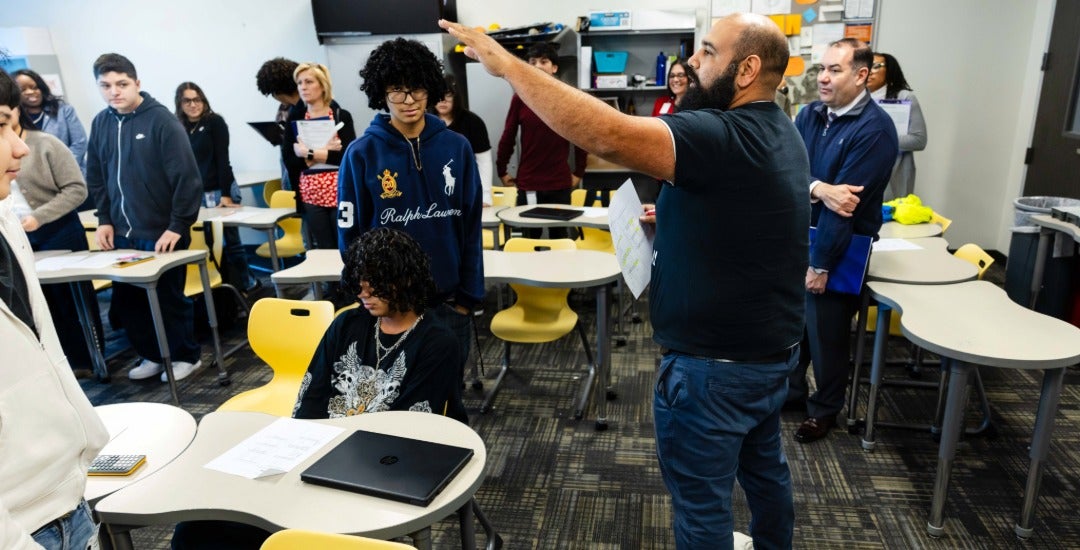
When Aldine ISD opened Avalos P-TECH School in 2019, the northern Harris County school district gave students a head start on both college and a career.
In addition to their regular high school classes, virtually all Avalos students take classes tailored to one of five career pathways offered by Lone Star College. At the same time, each student gets hands-on work experience with an industry partner, such as the technology conglomerate Cisco and Houston-based energy firm Wellbore Integrity Solutions.
“It kind of became the triple crown of opportunity for us,” said Brooke Martin, Aldine’s executive director of career and technical education.
By any academic measure, Avalos students have thrived. The campus has earned nothing but A and B ratings under Texas’ academic accountability system. Every member of the Class of 2023 and 2024 was considered college-ready by the state, with nearly half finishing an associate degree from Lone Star College and another half earning a workforce credential.
Inspired by the successes of schools like Avalos, school districts across Texas are increasingly adopting the P-TECH model, which involves a district, higher education institution and industry partner collaborating on a specialized program for high schoolers.
The rise of P-TECH programs follows calls from Houston leaders — including Flávio Cunha, director of the Kinder Institute for Urban Research’s Center for Economic Mobility — for deeper coordination between schools and employers, with the goal of raising local wages. Historically, Houston-area students who completed a career and technical education program were slightly more likely to be employed and earn higher wages than students who didn’t, Kinder Institute researchers have found.
P-TECH, short for Pathways in Technology Early College High Schools, is more college-focused and immersive in a specific industry than career and technical education classes prevalent throughout Texas schools.
Under the P-TECH blueprint, districts and their partners design a state-approved program that aims to get students ready for higher-paying jobs in high-demand fields, such as healthcare, computer science, cybersecurity and heating and cooling. Students ultimately take college classes and get hands-on workforce experience through industry partners.
“I believe that we’re changing family trees, one student at a time,” said Cathleen Tyson-Ferrol, director of dual credit at Lone Star College-North Harris. “It definitely exposes students to various fields in the workforce and allows more of them to graduate with a credential.”
While P-TECH enrollment remains relatively small, accounting for about 2% of all Texas high school students in 2024-25, the model has steadily grown since state leaders introduced it in 2018.
About 175 districts combined last school year to operate 275 P-TECHs, with the largest concentration located in the Dallas-Fort Worth metroplex and South Texas. Thirteen participating districts are located in the Houston area, including Aldine, Clear Creek, Fort Bend, Houston and Spring ISDs.
The P-TECH prototype
Texas’ P-TECH model puts a more jobs-oriented spin on the state’s longer-established Early College High School initiative, in which school districts and colleges partner to prepare more students for college-level classes.
While each P-TECH program looks different, the model calls for several consistent features.
Schools are expected to enroll students starting in ninth grade, with a particular focus on signing up lower-income students who aren’t highly likely to attend college. Classes must be tailored to students earning an associate degree or workforce credential aligned with local industry needs. And students must have opportunities for in-the-field learning through industry partners at every grade level.
“There’s much more deliberative work-based learning in that partnership with business and industry,” said Monica Martinez, the Texas Education Agency’s associate commissioner for standards and programs. “If I’m in a traditional high school and I’m interested in pursuing nursing, I’m likely taking very similar coursework, but I might not get similar work-based learning experiences.”
P-TECH programs typically enroll about 25 to 100 students per grade level, a limitation largely resulting from difficulty finding qualified instructors and willing industry partners.
In the Houston area, most P-TECHs are located within a comprehensive high school, while a handful have dedicated campuses. Healthcare and computer-oriented programs are most common, though available options range from aviation to automotive to interior design.
Each of the region’s four largest community colleges participate in local P-TECH programs. Industry partners include a few multinational corporations, several of Houston’s largest healthcare networks and more than a dozen local small businesses or trade organizations.
The expansion dilemma
State leaders said they’re encouraged by early results from the P-TECH model.
In the Class of 2024, about two-thirds of P-TECH graduates earned at least 15 college credit hours, typically the equivalent of a half-year of college classes. By comparison, only one-quarter of all Texas public school students earned at least three credits in math, reading or language arts or nine credits in any subject.
In addition, roughly one-third of P-TECH graduates from the class received an industry-based certification, on par with the state average.
Still, Martinez said she does not envision a large share of high schoolers joining P-TECH programs in the coming years, citing the intensive commitments needed from schools, colleges and industry partners. Rather, state officials hope to gradually continue expansion of P-TECH, without sacrificing the quality of the model.
“This is not the kind of thing you do with hundreds or thousands of students” per grade level, Martinez said. “It’s more probably 20, 30, 40 students. I think that creates some challenges in terms of scaling.”
Martin said training Aldine staff to lead P-TECH classes and finding industry partners with employees qualified to work with students have been top issues for the district, which now runs three P-TECH programs. Aldine leaders have successfully navigated those barriers so far, filling all P-TECH positions.
“One of our biggest challenges is just making sure we have those credentialed individuals, because sometimes they can make more (money) in the industry,” Martin said. “It takes a real labor of love and an instructor that really sees the impact and outcome for our students.”