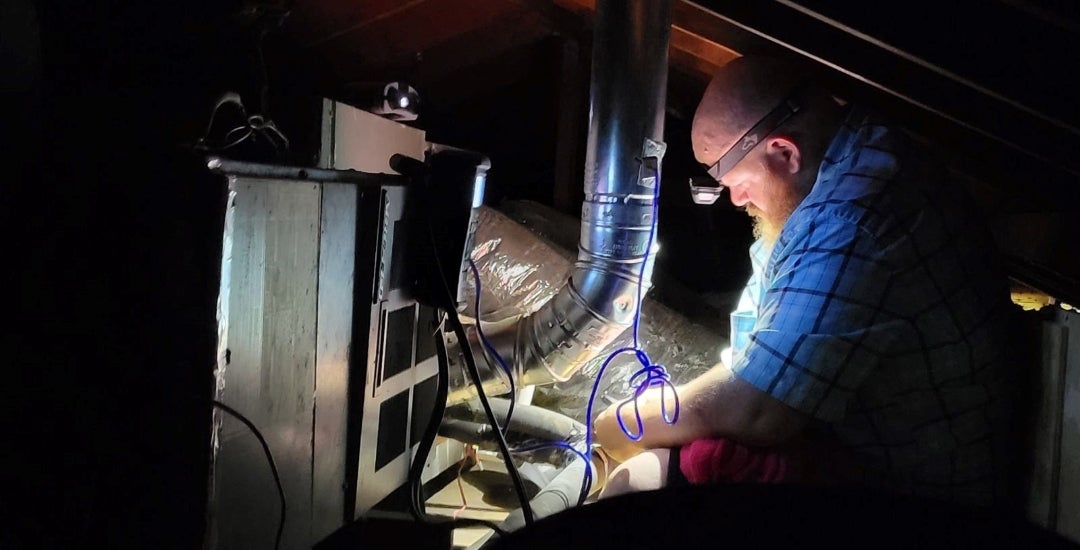
For some Houston residents, their home heating system leaves them with a cold feeling.
Early findings from the Kinder Institute’s ongoing Housing Quality Registry show roughly 1 in 8 respondents across Harris County reported they had no safe and reliable heating in their homes — results that suggest hundreds of thousands of local residents worried about staying warm as temperatures plunged over the past several days.
The survey also found 1 in 4 residents reported inadequate insulation in their homes and 1 in 3 had windows that didn’t help keep the cold out during the winter.
The Housing Quality Registry, a first-of-its-kind survey that aims to gauge conditions inside Harris County homes, drew about 930 responses in an initial round of surveying.
The total includes 285 residents of Alief and 85 residents of Kashmere Gardens, two neighborhoods where people were specifically encouraged to participate via mailed invitations. The remaining responses were collected through an open survey that remains available to all Harris County residents.
The results, while not statistically representative of the county, provide a glimpse into the experiences of local residents dealing with numerous housing concerns, including heating and cooling.
Researchers have repeatedly found cold conditions in homes may exacerbate physical and mental health issues, particularly for older adults, though the full extent of the negative effects aren’t well-studied. Makeshift heat sources, including some gas-powered space heaters and stoves, can also emit toxic levels of carbon monoxide if they’re improperly used in poorly ventilated areas.
“When most people think of Houston, they think about the heat, but 2021, 2024, 2025, and now 2026 have made clear we are not immune to life-threatening cold,” said Dan Potter, co-director of the Houston Population Research Center and lead researcher of the Housing Quality Registry. “Dealing with that cold can place households in much more precarious situations if they do not have a safe and reliable form of heat.”
Mapping the problem
While air conditioning often plays a larger role in residents’ daily life, last week’s chilly weather resurfaced home heating and insulation issues plaguing particular communities.
The survey results show lower-income Harris County residents are at significantly higher risk of living in homes without reliable heating. Roughly 18% of respondents with an annual household income of less than $50,000 reported a lack of safe and reliable heating, compared to just 1% of those earning more than $100,000.
In Kashmere Gardens, a lower-income neighborhood on the city’s northeast side, about 1-in-3 respondents reported no safe and reliable heating. A similar share said they rely on space or portable heaters to keep their residence warm, as opposed to central heating systems.
In addition, only about half of Kashmere Gardens respondents said their windows adequately keep the cold out in the winter and heat out in the summer, while only one-third said they had sufficient home insulation.
The lack of solid heating and insulation may stem, in part, from the aging housing stock in Kashmere Gardens, where the median residential unit was built 75 years ago. Residents of Alief in southwest Houston, where the median residential unit is about 45 years old, reported significantly fewer heating issues.
BakerRipley weatherization director Sommer Harrison, whose department fixes heating and cooling issues in about 200 local properties each year, said her team encounters a mix of homes without central heat and residences with run-down equipment. Many of the houses lacking central heat are located on the city’s north and east sides, where most homes were built before the 1960s.
“Any place that you go that has an older home, that doesn’t have a central system, they’re going to be using who-knows-what to heat the home,” Harrison said. “We’ll often find several space heaters there. It’s so imperative for residents to put carbon monoxide detectors in their house.”
Seeking better data
The Housing Quality Registry provides some of the most detailed data on home heating conditions, helping to fill an information gap for nonprofits and government agencies deciding where to direct resources.
The Census Bureau’s American Community Survey collects in-depth information about the source of heating inside homes — such as electricity, utility gas and solar power — but it doesn’t include data about the quality of those systems. Using this data, the Kinder Institute estimates about 32,000 households lack piped-in natural gas, electrical or solar heat, though about half of them may rely on propane heaters.
The American Housing Survey, also administered by the Census Bureau, includes data about how many respondents felt “uncomfortably cold” for 24-plus hours over the past year and the cause of any heating-related issues. However, the most granular available data is at the metropolitan statistical area level.
An estimated 220,000 out of 2.6 million Houston-area households were uncomfortably cold, with about 70,900 citing equipment breakdowns and 18,800 blaming inadequate insulation, according to the 2023 American Housing Survey.
“Knowing the scale of the need that exists reaffirms the importance of local nonprofits, such as Rebuilding Together Houston and West Street Recovery, who help families and households get their homes better prepared for the extreme weather of the region,” Potter said.
“Together, with support from local and state agencies, Houston can move toward having more of its residents in safe, healthy and affordable homes.”