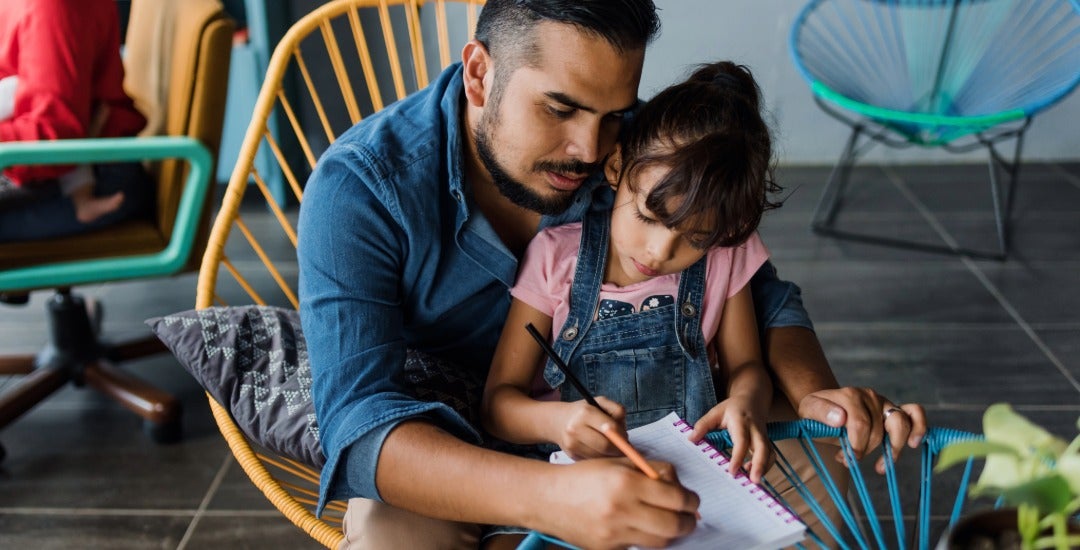
For South Texas resident Chelsea Gamas, an intensive, nine-month parenting initiative offered by the national nonprofit AVANCE promised to give her more confidence as a first-time mother.
Three years later, Gamas sews toys with her two daughters at home and carves out time each day for reading — activities she traces directly to the lessons delivered through the free program.
“Everything at home is a teachable moment,” Gamas said. “Whatever they worked on in class with my daughter, they made sure I knew about it, so I could bring it home and build on it.”
A new Kinder Institute study finds major benefits for families participating in AVANCE’s Parent-Child Education Program, or PCEP, an initiative designed to support predominantly lower-income and Latino households with children under the age of 4. About 3,300 adults and children took PCEP courses during the 2025-26 school year.
The study found adults made exceptional growth in their parenting skills, reporting increased confidence and engagement in their children’s learning. In addition, children made significant developmental and learning gains that continued months after the program ended.
The results echo, and by some metrics surpass, similar findings from researchers evaluating family education programs targeting other demographic groups across the U.S.
PCEP provides weekly, three-hour sessions to parents, with support ranging from child development classes to toy-building workshops to personalized home visits that reinforce learning. At the same time, children attend an early childhood program built around language, cognitive and motor skills.
At the request of AVANCE, the Kinder Institute conducted surveys with 245 families in Hidalgo County, located in the Rio Grande Valley, who took PCEP courses from 2022 to 2025, and evaluated multiple aspects of their children’s development. The results were compared to outcomes for children whose families applied to participate in PCEP but didn’t win a lottery spot.
“What we’re seeing is that we didn’t teach the child a trick that wears off. We changed the parent, and the parent kept teaching once the program was over," said Flávio Cunha, director of the Kinder Institute’s Center for Economic Mobility and a co-author of the report.
AVANCE has provided early childhood education and family support services across Texas and through partners in California and New Mexico for more than 50 years, serving more than 18,000 individuals annually. The organization operates in Houston, Austin, San Antonio, Dallas and the Rio Grande Valley. PCEP, its flagship initiative, is built on the premise that parents are their children's first teachers.
Teresa Granillo, who has served as AVANCE’s CEO since 2019, said the new findings reinforce that mission and open a path toward broader impact.
“These findings are powerful,” Granillo said. “They not only position us to continue to deliver this program, but also to expand our reach, so that more children and families can experience both the short- and long-term benefits of the program.”
Breaking down the results
To evaluate the impact of PCEP, Kinder Institute researchers conducted parent surveys and child development tests before, during and several months after completion of the program.
The study found children in PCEP showed the equivalent of roughly four additional months of development across multiple measures at the time of program completion compared to children whose families didn’t participate.
Most strikingly to researchers, the gains rose to 4.5 additional months of child language and literacy development and 6.5 additional months of physical, perceptual and motor development after the program ended.
“Most programs show large gains at midline and endline, and then the follow-up assessment shows the impact has faded — sometimes disappearing entirely, sometimes even reversing,” Cunha said.
Notably, the estimated impact of PCEP on cognitive development did fade from 4.4 months when the program ended to 0.8 months on follow-up tests.
Researchers said the strong persistence across most measures traced back to a measurable shift in what parents did at home. Compared with families who didn’t participate in the program, parents in PCEP reported reading more with their children, spending more time teaching them and more often turning everyday moments into learning opportunities.
The study also found substantial changes in how parents viewed their own futures, with the largest effect on their belief that they can improve their family’s economic circumstances.
“When parents first start the program, it’s really about wanting to be a better parent — it’s all about their child," Granillo said. “But the more time they spend together, they talk about the economic struggles they’re facing, or hopes and dreams they’d had before. Our instructors pick up on that and bring in resources to help move them along in their economic journey.”
A ‘go-to program’
AVANCE said it hopes the study’s findings will help grow PCEP’s reach across Texas and beyond.
For now, the organization aims to deepen its presence in communities where it already has staff and infrastructure in place. AVANCE has offered the PCEP program to Houston-area children and adults since 1988, with 130 served this past year.
Additional partnerships with school districts, Head Start and Early Head Start programs also would allow AVANCE to bring PCEP to families those organizations serve. Such arrangements involve cost-sharing between AVANCE and its partners, with philanthropic support covering costs where available.
AVANCE also hopes to license the PCEP curriculum to additional organizations beyond its partners in California and New Mexico, with the nonprofit providing training to support implementation.
“We want PCEP to be the go-to program for organizations looking to simultaneously increase parent engagement, school readiness for young children and family economic mobility,” Granillo said.
The Kinder Institute’s Center for Economic Mobility plans to continue tracking participating families through Texas state administrative records — following children's school performance and parents' employment and earnings over time — to determine whether the early gains translate into longer-term outcomes.
“We can work all day long with a child,” Granillo said. “But if the home environment doesn't change alongside what we're doing, none of it will stick.”