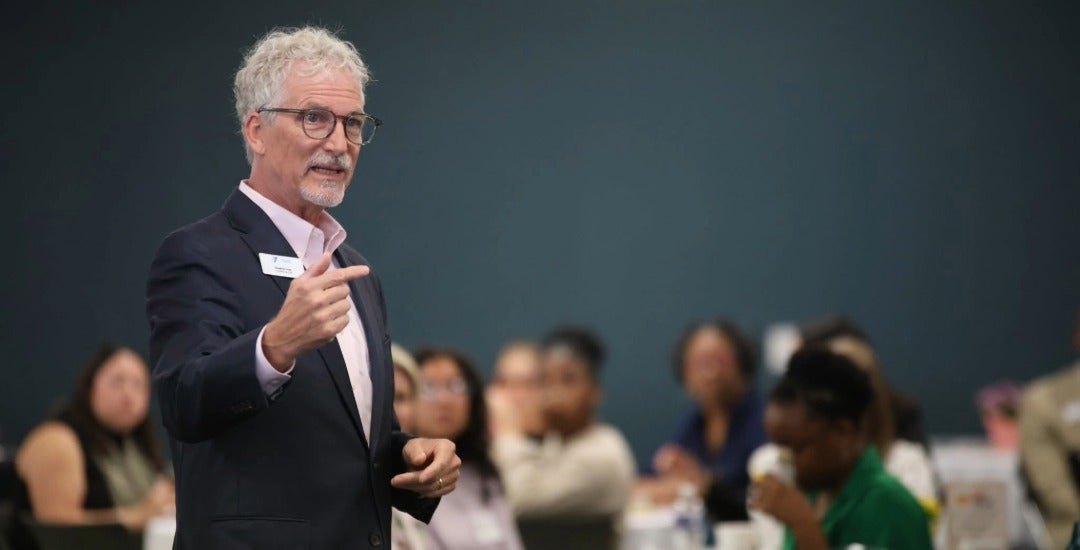
This time last year, YMCA of Greater Houston President and CEO Stephen Ives made a pitch to local leaders: Join us in combating loneliness and increasing connectedness across the region.
Today, Ives sees signs of progress since issuing his call — with much work still to be done.
In an interview with Urban Edge earlier this month, Ives said he’s been heartened by several local organizations adopting the mantle of belonging over the past year, infusing it into their long-term plans and launching initiatives that bridge communities. At the same time, Ives, who has led the regional YMCA since 2016, said local leaders continue to face challenges in reaching residents dealing with the current economic, social and political landscape.
The YMCA of Greater Houston has taken a lead role in building grassroots and institutional support for tackling loneliness, which the U.S. surgeon general deemed an epidemic in 2023. The organization collaborated with the Kinder Institute for Urban Research on a survey published in September 2025 that measured how 5,000-plus local residents felt about their personal sense of belonging, connectedness and achievement in Greater Houston.
In the interview, Ives detailed evidence of progress over the past year, outlined opportunities for building on early successes and explained why he’s optimistic Houston will overcome hurdles in connecting with residents.
The following transcript has been edited for clarity and length.
Q: It's been one year since you called on the Houston community to collaborate on the issues of connectedness and loneliness. How would you assess progress on this front?
A: I would say we've made great progress in building more and more momentum and alignment amongst community leaders and organizations. Connectedness, overcoming loneliness, (building) a more connected community, is a really important North Star for us to organize and rally around, and that's shown up in some of the workshops we've had. I’ve noticed that even the work that Houston Endowment and others are doing around their future focus and strategic plans are using language like “community well-being” and “connection” and “belonging.” The work of the Kinder Institute and the study and the publicity and dialogues around it are starting to really take root in some meaningful ways.
Q: What are some of the most meaningful ways you’ve seen tangible progress or conversations take place?
A: American Leadership Forum has really leaned in to build out Bridge Houston, the idea of bridging across differences, creating connections across differences and building out skill sets. So they've been very active in helping to implement their area of focus, which is leadership development and community development. They've had workshops, I've been invited to other things that other people are leading, which is always a good sign that we’re not leading everything and the Kinder Institute isn’t leading everything. And then, a couple of other groups (and) individuals that were part of a couple of our community dialogues have really started to take action in their neighborhoods to create connection groups and be thinking about and acting in a way that helps neighbors to know neighbors.
Q: How has the YMCA of Greater Houston acted in the past year to address these issues?
A: We formalized a strategic plan approved by our board in July that is completely referenced around and focused on elevating the degree of connection and belonging that people experience in the Greater Houston area. We had a task force that brought the proposals to the board. So internally, building out a greater understanding among the board members and staff around what it means on a practical basis from a program and execution (standpoint).
Q: What are some elements of that plan that the average member at the Y might tangibly see in their day-to-day experience with you?
A: We are thinking about it and behaving about it in internal and external contexts. Internally, in our programs, I will call it intentionality around helping people getting space where they can get to know each other or get to know people they might not have known had they not joined that group exercise class or that youth program or that camp. It's very much part of our language, but also part of our orientation and training for our staff who are delivering programs.
We're also building out and finalizing a larger strategy around how our facilities go up and some reworking of spaces in our facilities to be more facilitative of connection and belonging. And we've got a few examples of that from previous rebuilds, and it's going to be very much a theme of our future visioning for what we do with our buildings. So that will become visible as that takes root over the next few years.
The external is the participation we've had in partnership with the Kinder Institute, the Houston Food Bank and the American Leadership Forum to elevate this issue and have conversations and discussions to motivate and encourage a broader army, if you will, of connectors in the community who are building their own plans around it. On the external side for us, the way in which the Houston Food Bank is positioning the new CORE project, which just did a groundbreaking and will open in a couple of years, completely revolves around not just delivering food, but connecting people and communities around the delivering of food, having a hub where multiple entities are delivering resources and support for people, and helping people across different backgrounds be in community together inside that building.
Q: You wrote last year that research on connectedness and loneliness “should spark conversations — in neighborhoods, city halls, classrooms and faith communities.” To what extent do you think that has or hasn't happened?
A: That vision that I shared is a long game, so I would say that’s beginning to take root each time we do a gathering. The American Leadership Forum did a big, two-day gathering and workshop on bridging, and bridging across differences is a core component of training connected communities and a greater sense of belonging for everybody.
The work we've been doing internally for a couple of years, around really elevating our engagement with faith communities through our Christian emphasis, has begun to build a community around not just the Y, but around this issue. I think that's a huge community that, naturally, is designed and set up beautifully to influence connections among the parishioners and neighbors and people they serve.
Q: What are the biggest challenges you see in sparking deeper conversations and deeper work on these issues?
A: There's a lot going on in our world, and it’s easy to get distracted and for this to get lost in the noise of what people are navigating through economically, politically, socially. I think I would call those headwinds or potential headwinds that we just need to continue to work through and move past.
Q: There are organizations that have been working to bring people together for decades and decades. At the same time, there's not a ton of built-in infrastructure that is explicitly designated for addressing these issues, especially between organizations. How do you view the state of infrastructure that allows you to bring organizations together and do this type of bridging work?
A: Well, I guess I would push back a little bit on the idea that there's a lack of infrastructure. I think there's a lot of infrastructure. We've got a United Way that knits organizations together, got a number of coalitions around specific issues like homelessness or workforce development. What has been lacking is the intentionality and focus. We do this to bring food to people or to solve needs, and we do this collectively in order to create a more tightly knit-together community. And I think that's where the magic is. A lot of times people see a problem or an issue to address and want to set up a new institution. I think we’ve got all the institutions we need.
Q: Has there been a moment or development or theme of the past year that left you most encouraged?
A: I work within a network of YMCAs across the country that has a national office. And our national office has named and called out building connected communities as the primary North Star purpose for YMCAs. We were just heading in the right direction to align with our national offices and our large network across the country, which are in 2,500 locations. We have Ys within a 10-minute drive of 80% of the U.S. population. The ability for a national influence with what we build here in Houston to be replicated is pretty exciting to me.
Q: Have you seen in this work any particularly effective strategies, either locally or nationally, for combating loneliness or organizing to tackle the issue?
A: I think there's a lot locally. There's an organization called Fit Houston that is doing community walks. It’s brilliant, it's grassroots, it’s neighborhood by neighborhood. A lot of times, we think we've got to have the solution that is scaled and large, and millions of people. I like to use the words “hand-to-hand combat.” This is grassroots, in the neighborhood, in the streets, building a legion of connectors and bridge builders. I think that's where the magic is gonna come from this, and we’re already seeing some signs. You think of the work of the Food Bank, as they're bringing in volunteers to prepare food for people who have a need, finding a way for the two populations to intermingle, mix a little bit.
There's a great book called “Building Communities from the Inside Out.” It gives a bunch of anecdotes and stories around how we deliver “service to,” this idea of building community “with” through a soup kitchen, through a food distribution system. We stop asking volunteers (to do work) “to” or “for” other people, but to do it “with.” I think there’s magic in that. It’s a nuance of the stuff we’re already doing.
Same with the Y. We do great swim lessons and group exercise classes and summer camps and youth programs and family opportunities that individual families can enjoy. But we ask them why they love the Y, (and they say,) “I met great people there,” “I have friends that have lasted a lifetime there,” “the staff were so friendly and welcoming.” It’s that, more than “I lost so much weight” or “my body looks better” or “I feel different.”
Q: What do you think the Houston community needs to do over the next few years to make real progress on building connectedness and reducing loneliness?
A: I think we have to keep it front and center. I think there's probably an opportunity for some PR around it. I think the institutions like the Greater Houston Partnership, like the school system and the churches — all of these large, influential institutions, we’re not asking them to do anything new and different other than be mindful and consider connection and belonging as an intention behind the good work they're already doing. It's not a big left turn. It's about pouring gasoline on a lot of stuff that's already happening.
The beautiful opportunity we have in Houston is it's built into our DNA. I witnessed this and experienced it being a newcomer to the city eight years ago. This city is far ahead of other big cities in its willingness and openness to accepting new people, new ideas, and wanting outsiders to come in and be successful and help make things better. We pride ourselves as not just Southern hospitality. There's something in the water here in Houston that we can build upon. So I think it's just “intentionality” is the word I'd use.
Q: How, if at all, do you measure the efficacy of this work and any progress you are making?
A: So internally with the Y, we've got this baseline study that we did. We can periodically test and retest to see if members are experiencing connection and belonging, along with loving their experience at the Y. Every month, we have a customer service kind of survey, but we do ask, “Have you made friends? Do you feel a greater sense of connection as a result, or greater sense of belonging?” So we can measure what our participants report in terms of their experience.
And then, I'm hopeful this study we did recently with the Kinder Institute, the Kinder Institute can help us with when's the right time to retest this and evaluate whether progress has been made at a community-wide level. I think that's the most powerful piece of all of this. There aren't a lot of issues or dynamics or social things we're working on that we actually have a baseline that we can say, “Here's where it was two or five or seven years ago,” and you evaluate whether what we've been doing so far is improving, building, strengthening, or not. If it's not, then we get to tweak our strategy.