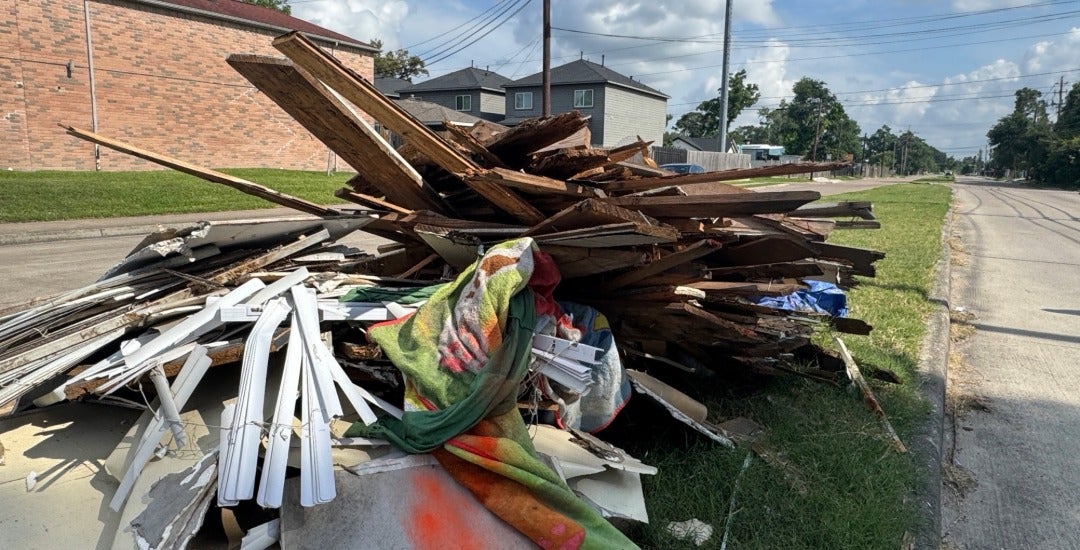
Federal oversight brought more eyes and dollars to Houston’s persistent illegal dumping problem. But city data suggests trash continues to pile up across the city, particularly in lower-income neighborhoods exasperated by years of illegal dumping.
Calls to the city’s 311 helpline and garbage collections related to illegal dumping have risen over the past two years, a period during which the Department of Justice monitored a new, $18 million city plan to combat the problem under terms of a civil rights case settlement. The Trump administration quietly ended enforcement of the settlement this year as part of a broader environmental justice pullback, the Associated Press reported earlier this month.
In announcing the settlement in 2023, city leaders touted the dumping plan — dubbed One Clean Houston — as a major investment in addressing and curbing illegal disposal of trash. The plan included $11.5 million for additional trash cleanup over three years, about $1 million for surveillance cameras and enforcement staff, and several other commitments.
City data shows staff members collected dumped trash at slightly higher rates than before the federal involvement — an increase that could signal improvements in the city’s response to illegal dumping, but also suggests Houston officials haven’t significantly deterred dumpers.
City officials also have received more than 8,000 requests through Houston’s 311 helpline to address “trash dumping” or “illegal dumpsites” in 2024 and 2025, eclipsing the number of requests submitted prior to the federal intervention.
Moreover, the highest concentration of 311 calls and trash collections continued to emanate from several of the city’s lowest-income neighborhoods, including Acres Homes, Greater Fifth Ward, Sunnyside and Trinity/Houston Gardens. The federal intervention followed findings that city officials neglected to address illegal dumping in many of those neighborhoods.
“That agreement laid out commitments being made by the city to remedy this problem. I don’t think all of those made it all the way through,” said Amy Dinn, the managing attorney for Lone Star Legal Aid’s environmental justice team, which helped file the civil rights complaint that led to the settlement.
“It doesn’t seem like we received all the commitments that were supposed to be made, because we’re still having this problem today.”
In written responses to questions, Houston Solid Waste Management Department Director Larius Hassen said the city has “has long recognized illegal dumping as a serious quality-of-life issue” and will continue to carry out its strategies for curtailing the practice.
“While we understand the frustration, the end of federal monitoring does not change the city’s commitment to keeping Houston neighborhoods clean,” Hassen said. “The city continues to tackle illegal dumping citywide using additional contractors, police enforcement and surveillance technology. Residents should be assured that these efforts remain ongoing and that the city’s focus is on long-term solutions, not short-term compliance.”
Hassen added that the increase in 311 calls could reflect “greater public awareness and increased use of the reporting system,” rather than more illegal dumping.
A short-lived solution
Illegal dumping has plagued parts of Houston for decades, even as city leaders have launched programs and made pledges to tackle the issue.
In a mid-2023 Kinder Institute survey related to that year’s mayoral election, roughly one-quarter of residents identified illegal dumping as an environmental issue in their neighborhood.
Aggravated by the prevalence of illegal dumping on the city’s northeast side, community leaders joined with Lone Star Legal Aid to file a federal civil rights complaint in early 2022, alleging years of neglect by city officials.
The Justice Department launched a civil rights probe that summer, examining why Houston’s predominantly Black and Latino neighborhoods were left drowning in trash.
Then-Mayor Sylvester Turner defended the city’s handling of illegal dumping, but the city ultimately launched One Clean Houston in March 2023 and reached a settlement with federal officials that included three years of oversight. The settlement mostly required the city to carry out One Clean Houston and submit a few reports each year about progress to federal monitors.
Trump administration officials have not commented on the decision to scrap the agreement. Following the end of a similar settlement in Alabama earlier this year, a top Justice Department official said the agency “will no longer push ‘environmental justice’ as viewed through a distorting, (diversity, equity and inclusion) lens.”
‘Something has to be done’
Local leaders were optimistic about the plan and federal involvement, though their enthusiasm ultimately waned as dumping remained a problem.
Warren Fitzgerald Muhammad, the CEO and board chairman of the Acres Home Chamber for Business and Economic Development, said illegal dumping is an “ever-present” struggle in the northwest Houston neighborhood. He cited a lack of surveillance cameras and the challenge of successfully prosecuting offenders as barriers to curbing illegal dumping.
"It’s constant," said Fitzgerald Muhammad, a lifelong resident of Acres Homes. “We made a lot of noise about it in October and complained on the news. Particular corners were cleaned up, but it’s still a problem that hasn’t been rectified because the dumpers always find somewhere else within a matter of blocks.”
Huey German-Wilson, president of Super Neighborhood 48 in Trinity/Houston Gardens, echoed that frustration, describing a double standard in how the city responds to illegal dumping.
“In some form or another, we are always putting in 311 requests or talking to our council member's office. But in some areas, illegal dumping has never been picked up,” said German-Wilson, founder of the Northeast Houston Redevelopment Council. “It just sits there as though that's the place where it's supposed to be.”
Dinn argued a lack of trucks, staff and other resources are the ultimate root of the problem. She suggested a monthly garbage fee — which Houston doesn’t have, but Texas’ other large cities charge — could help address the issue.
A 2023 Kinder Institute survey found 65% of Houstonians supported a monthly garbage fee of at least $10. However, just 12% backed a fee totaling $35, an amount more in line with the monthly charges in other large Texas cities.
"There are ways to raise money to address this issue,” Dinn said. “We’re the only major city in Texas without a trash fee. It's always an additional burden to put more fees out there on the community. But something has to be done to make sure that trash gets picked up. That's something cities are supposed to do.”