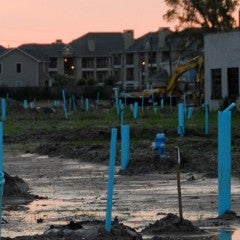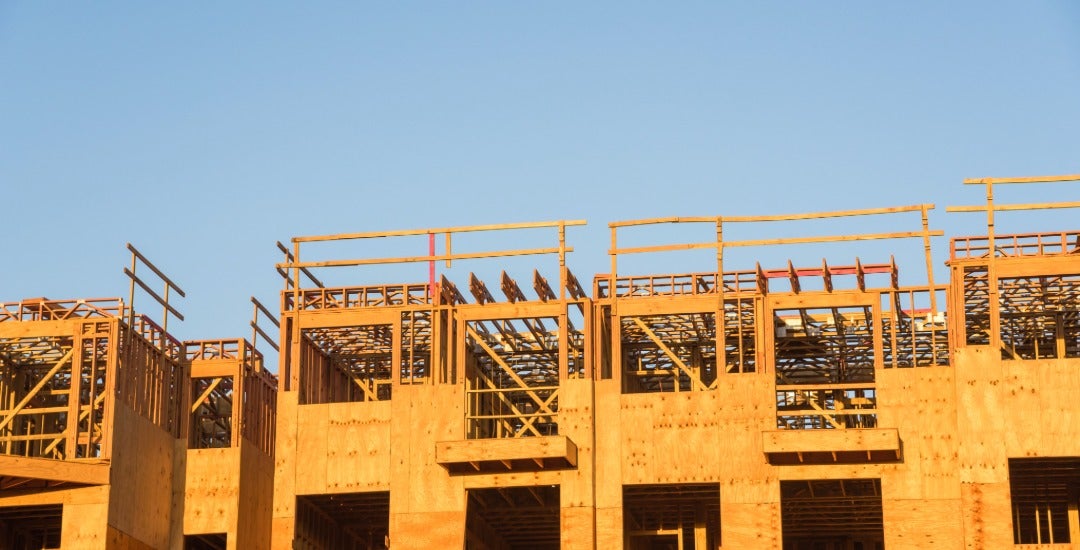
Harris County developers are increasingly building upward and outward.
American Community Survey estimates show the county added 30,700 multifamily living units in 2024, outpacing construction of single-family units by the largest total in recent history, according to the Kinder Institute for Urban Research’s 2026 State of Housing in Harris County and Houston report.
The increase in multifamily units, up 4.2% year over year, follows deeper developer investment in apartment buildings across Houston’s suburbs and inside the city’s urban center, where more middle- and higher-income residents are renting instead of buying.
The share of Harris County households who rent rose from 44.8% in 2023 to 46.2% in 2024 — a shift Kinder Institute researchers and local advocates partially attributed to the mounting costs of homeownership over the past several years.
"High interest rates and rising costs of homeownership, particularly for insurance and taxes, have coupled with plateauing rents the past two years and a large supply of multifamily rentals,” said Kinder Institute research scientist Steve Sherman, a co-author of the report. “Put together, this means that renting may be seen as a better medium-term option for younger households."
Multifamily units remain less prevalent than single-family homes, which account for about three-fifths of housing units in the county. But the number of new multifamily units blew past the 2,100 single-family homes added in 2024, a year-over-year increase of 0.2%.
The ACS defines a multifamily unit as each living space within a structure that has more than one living space.
The 2024 data continues a short but notable trend of developers preferring to build apartments, condos and townhouses over standalone homes. Between 2022 and 2024, Harris County added 74,500 multifamily units and 25,300 single-family units, according to ACS estimates. Data for 2025 construction isn’t yet available.
“The renter base is broad, younger and middle-income,” said Clayton Eddy, a development associate at Wood Partners, which has built 13 apartment complexes across the region. “More households are renting longer due to affordability pressures, though easing home prices and (mortgage) rates may shift some back to buying.”
The ‘bull’s-eye’ effect
As developers have expanded the county’s multifamily footprint over the past decade, they’ve largely targeted the outer and inner core of Harris County.
In the suburbs beyond Beltway 8, developers added 35,900 units between the second half of the 2010s and first half of the 2020s, an increase of 13.3%, according to ACS estimates. The largest concentration of growth came in the Katy and Klein areas, with notable additions of multifamily units in Atascocita, Baytown, Clear Creek and Cypress.
As more residents and companies have gravitated toward the suburbs, developers have responded by constructing newer apartment buildings with higher-end finishes and amenities, typically commanding higher rents than older apartments.
"Suburbs offer cheaper land and strong demand, but they’re also where supply is heaviest, so competition is highest,” Eddy said.
Closer to downtown, builders added about 25,100 units inside Loop 610 during the same time frame, a 22.1% increase. The Downtown, East Downtown, Heights and Midtown neighborhoods accounted for much of that growth, largely through construction of higher-end apartments.
Meanwhile, the area between Loop 610 and Beltway 8 — home to a large share of the county’s older apartment stock — grew just 5.1% over the same period, adding about 12,800 units. Many of those neighborhoods lack immediate downtown proximity, while larger tracts of land are more expensive and scarce than in the suburbs.
“If you looked at a heat map of where new multifamily properties have come online, it would almost look like a bull's-eye — really in the center and really around the periphery,” Sherman said.
Still seeking relief
For many Harris County renters, the additional multifamily inventory hasn’t made housing more affordable.
For the first time on record, more than half of Harris County renters were cost-burdened in 2024, meaning they spent more than 30% of their household income on housing costs. An additional 30,000 renter households crossed the threshold in 2024, bringing the share to 51.2%. By comparison, about one-quarter of households in owner-occupied units were cost-burdened.
Eddy said new development has tapered off in recent months, resulting in rent concessions and slower rental price growth that are improving affordability. Still, he said demand for rentals remains strong among residents.
Sherman noted that the changes in multifamily and single-family construction trajectories aren’t large enough to alter a central housing dynamic of the region: Most Harris County residents are still homeowners, while most city of Houston denizens rent.
“While a lot of development of new multifamily is happening in Harris County, the amount of catch-up they have to do to catch Houston is pretty huge,” Sherman said. “I don’t foresee that happening anytime soon.”