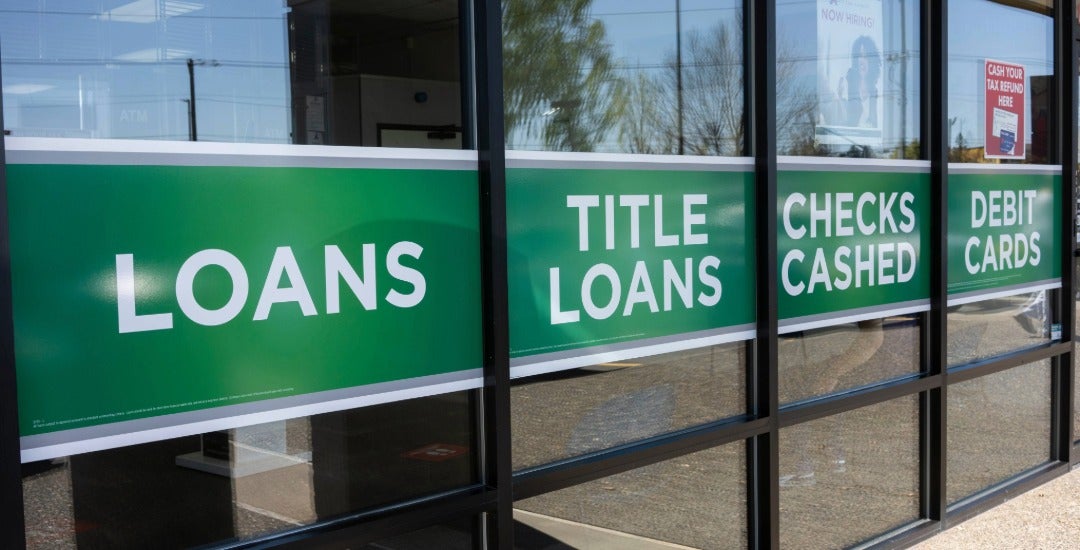
Houstonians rely on payday loans at significantly higher rates than most Americans — and paying an exceptionally high price for them.
A new Kinder Institute survey gauging the use of predatory lending products in Houston found about 12% of more than 5,000 respondents took out a payday loan in the past year, most often using the quick cash infusion to cover basic necessities like food and shelter. By comparison, just 1.1% of nearly 25,000 people who participated in a federal survey used a payday loan in 2023, the most recent year with available nationwide data.
Texas residents are particularly vulnerable to the perils of payday loans, which typically provide borrowers with a few hundred dollars that must be paid back — with abnormally high interest and fees — after they receive their next paycheck. The state’s lenders charge some of the nation’s highest interest rates, fees are largely uncapped and government oversight is limited, according to The Pew Charitable Trusts and the Center for Responsible Lending.
As a result, borrowers often spend far more on interest and fees than their payday loan amount. In 2024, Texas borrowers paid roughly the same amount in fees alone ($1.3 billion) as they received in new and refinanced payday loans, state data shows.
“People resorting to payday loans solve a problem today but the loans make things worse in the future,” said Ann Baddour, director of the Fair Financial Services Project at Texas Appleseed. “A $200 loan for less than six months can cost more than $1,000 to repay under some of these schemes. Sometimes people are desperate enough that they take the deal.”
While some states like Texas put few guardrails around payday loans, the regulatory landscape looks markedly different in other parts of the country. Eighteen states do not have payday lenders, either because they ban the practice or set interest rate caps so low that there’s no business market, according to The Pew Charitable Trusts.
Who uses payday loans
Predatory lending products are a fixture of the Houston metro area, which has the nation’s highest poverty rate and nearly 850,000 households making less than $50,000 annually.
About 19% of Houston area respondents said they had used at least one of four predatory lending products — payday loan, pawnshop loan, auto title loan or tax refund advance — in the past year. Nearly 60% cited food or groceries as the primary reason for borrowing, while about half used the funds for rent, mortgage or other regular living expenses. One in 12 said they spent the money on discretionary expenses such as a vacation or gifts.
Payday loans ranked as the most commonly used predatory lending product, with stark disparities in who relied on them.
About 20% of Black respondents and 14% of Hispanic respondents reported using a payday loan in the past year. By comparison, White respondents (5%) and Asian respondents (4%) used them at far lower rates.
Household income, age and family status also played into reliance on payday loans.
Roughly 1 in 5 respondents earning less than $25,000 in household income used a payday loan, as did about 1 in 7 earning between $25,000 and $50,000.
Usage was highest among adults between the ages of 30 and 49, peaking at 1 in 6.
“What this tells us is that payday loans are about people surviving, not spending recklessly,” said Dan Potter, director of the Kinder Institute’s Houston Population Research Center. “For many families and households whose wages are not keeping up with the costs of their basic necessities, they are having to turn to these products to make ends meet.”
Cost of doing business
Payday lenders issued or refinanced 1.9 million loans in 2024, operating in one of the nation’s most lax regulatory environments for the industry.
While state legislators have capped interest rates on many types of loans, payday lenders evade such limits by operating as “credit access businesses,” which aren’t technically classified as lenders. Instead, they act as brokers, arranging loans from third-party lenders and charging separate fees to service and guarantee those loans.
Baddour said this structure allows payday lenders to sidestep Texas’ interest rate limits, resulting in annual percentage rates that regularly exceed 500% and 600%. Home interest, credit card and car loans typically carry APRs in the single or low-double digits.
“Texas stands out in the country for the convoluted model that these companies use to get around our interest rate caps,” she said. “They can charge whatever they want. What we see, sadly, in the market is that they do. These are loans that are set up for failure, and they’re squeezing people so that these companies have already earned back what they lent and more in fees after just a few payments.”
While some Texas cities, including Houston, have adopted local ordinances intended to curb payday lending, such as limiting refinancing or requiring borrowers to pay back part of the loan each time it is renewed. Those measures have been uneven and difficult to enforce.
The question of how, or whether, to rein in payday lending ultimately rests with the state, Baddour said.
“Instead of playing this cat and mouse game, the most reasonable course is for the state to take action and rein in these abusive practices,” Baddour said. “A growing number of states have adopted 36% rate caps. Here in Texas, given the market that we have, a reasonable solution would be to regulate payday loans just like other loans."