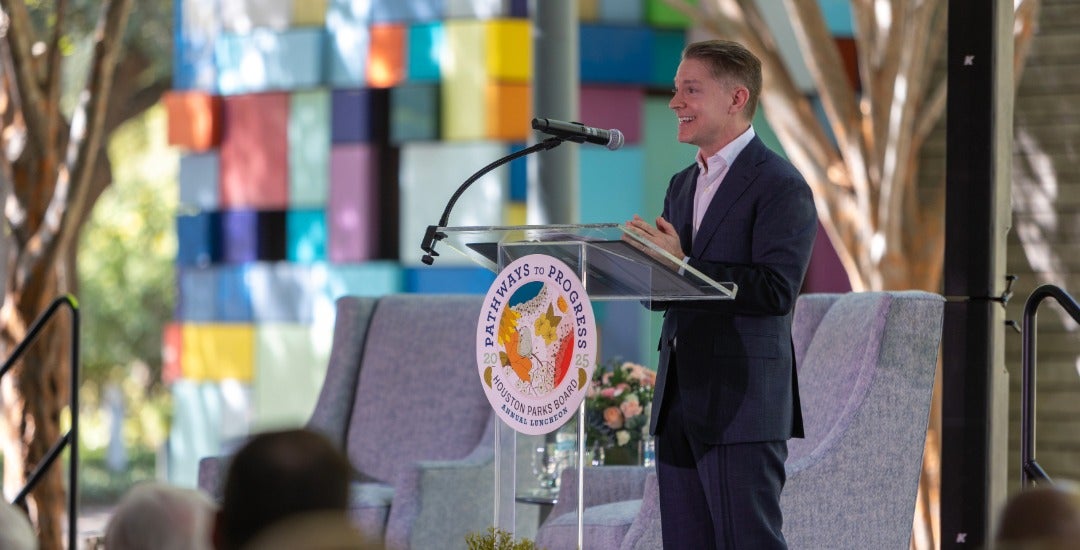
Justin Schultz began his role as CEO and president of Houston Parks Board on New Year’s Day. But he already has his sights set on Houston’s bicentennial in 2036.
By then, Schultz said, Houston should have one of the best park systems in the nation, overcoming its historically meager public investment in green spaces.
To help realize that vision, Schultz, an urban planner who previously served as Houston Parks Board’s chief program officer, has big plans for the region’s largest nonprofit dedicated to improving green spaces. In an interview before his ascension to the organization’s top role, Schultz laid out a short-term goal of executing major projects already underway and long-term plans for overcoming persistent challenges, including funding, excessive heat and coordination between governmental entities.
“There’s so much positive momentum over the last 25 years in green space in Houston,” Schultz said. “But we need to make sure that we are taking advantage of this amazing opportunity that we’ve been given to continue to transform our park system.”
Schultz took the helm of Houston Parks Board this month following the retirement of Beth White, who led the nonprofit for nearly a decade. The organization guides some of the region’s most ambitious parks initiatives, often in coordination with local governments, nonprofits and other entities.
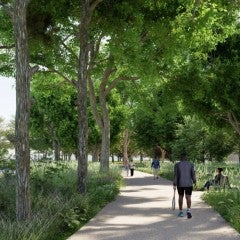
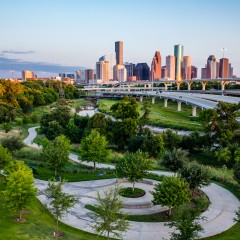
For now, Schultz’s focus is on implementing a five-year plan adopted in 2024 and completing landmark projects already underway. They include the Hill at Sims Park, a $30 million transformation of a detention basin into more than 100 acres of parkland in Houston’s Sunnyside neighborhood; the $60 million revitalization of MacGregor Park southeast of downtown; and the expansion of over 150 miles of trails and green spaces connecting the region’s major bayous.
But Schultz also aspires to improve the region’s approach to investing in and developing green spaces — changes that could impact projects for decades to come.
The funding gap
While recent milestones mark visible progress toward improving green spaces in Houston, the region continues to trail other metro areas in quality and quantity of parks.
Houston ranked 66th out of 100 cities last year in the Trust for Public Land’s ParkScore Index, which measures acreage, access, investment, amenities and equity. The analysis did not include an examination of conditions in unincorporated Harris County or neighboring counties.
In a 2025 Kinder Institute survey of nearly 10,000 local residents, about one-quarter of respondents rated the region’s parks and green spaces as “fair” or “poor,” with the rest deeming them “good,” “very good” or “excellent.”
Schultz said transforming Houston into a top-tier parks city requires navigating persistent funding gaps.
The citywide investment in parks totaled $151 per person in 2024, well below the average of $192 per person among large metro areas, according to the Trust for Public Land. Private donors in Houston provided a disproportionately large share of the funding relative to other cities, while local governments delivered below-average funding.
“The private funding is incredibly impressive. It’s greater than almost any other city in the country,” Schultz said. “But it is never going to be all that we need to have a good, working public park system.”
Schultz said the nonprofit’s leadership will continue to emphasize the economic benefits of parks to public and private funders.
“One of the things that we are really striving to do is to make sure parks are front of mind as a priority for the residents of Houston, for our elected leaders,” he said. “Parks are not a 'nice to have.' These are an essential public good like police, fire and other emergency services.”
The heat barrier
While national rankings focus on acreage and investment, Schultz knows that for Houstonians, the quality of a park is often dictated by the thermometer. In a 2023 Kinder Institute survey, 66% of residents who said they do not use parks cited extreme heat as the most common reason.
Planting more trees, building more shade structures, and adding more water fountains and misting features will be a priority for Schultz.
“In 2030 and 2040, it's going to be a lot hotter than it is today,” Schultz said. “We really need to think with our partners in the public sector how to collectively address this. I see our greenways as a laboratory for new interventions to reduce heat impact, but there are steps we can take to make the conditions more tolerable.”
Regional vision for 2036
Regional organizations like Houston Parks Board often face logistical challenges coordinating with the area’s numerous local governments, management districts, municipal utility districts and tax reinvestment zones.
Schultz, however, said he sees an opportunity to pursue new partnerships in Houston, Harris County and beyond.
“Part of what we need to do is make sure that we are looking beyond our individual borders,” he said.
“We want to continue to build bridges and literally build trails to other communities. We're working with the city of Pasadena right now. We can see ourselves working with our neighbors in Fort Bend County and Montgomery County. The bayous don’t stop at our city’s edge or our county’s edge, so why should our greenway system?”