
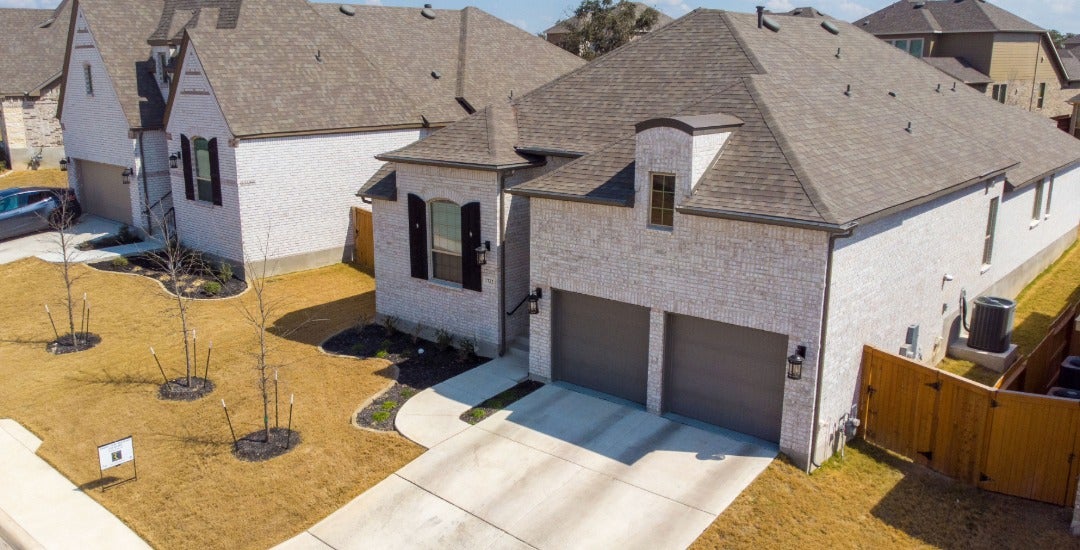
Houstonians looking for the perks of a newly constructed house without the burden of a down payment and mortgage have increasingly found refuge in the region’s burgeoning build-to-rent market.
But development of those properties could soon be foreclosed on by an unexpected source: Congress.
Houston’s small but fast-growing build-to-rent segment — in which companies construct new single-family homes and townhouses specifically to lease them — faces a major threat from federal legislation that would force most developers to sell their new properties within seven years of completion.
The provision is included in a sweeping bill designed to address housing affordability and supply that passed with near-unanimous approval in the Senate earlier this month. Its fate, however, remains in limbo in the House, where some lawmakers have opposed the mandate.
Supporters of the provision argue it will shift more of the housing market from corporate America to individuals, allowing more families to achieve the dream and benefits of homeownership. Critics warn that such a mandate would essentially kill the build-to-rent industry in markets like Houston by making it financially unviable for developers, further exacerbating the nation’s housing supply issues.
Houston’s build-to-rent market remains relatively meager, with about 12,500 housing units completed and another 2,200 in the pipeline, according to the homebuilding data firm Zonda. However, a cadre of build-to-rent developers has steadily invested in the local market, often targeting millennials, younger retirees and middle-income suburban families.
Rising home prices, down payment costs and mortgage interest rates have made the properties particularly attractive to renters. According to the Kinder Institute for Urban Research’s 2025 State of Housing report, the homeownership affordability gap — which measures the difference between how much a median-income household can afford to spend on a house and the median home sale price — reached an all-time high of about $127,700 in Harris County in 2024.
At the same time, nearly half of Harris County renters are cost-burdened, meaning they’re spending more than 30% of their income on housing. Renters also don’t accrue equity in their property, forgoing the potential long-term financial benefits of homeownership.
“There’s a short-term gain of having a nice house to come home to every day, which is a much more tangible and immediate experience than this more amorphous idea of building wealth through your home, which you might have to wait for years to enjoy,” said Caroline Cheong, the associate director of Housing and Neighborhoods at the Kinder Institute for Urban Research.
Inside the sector
Across the nation, corporate developers are increasingly dipping their toes into the build-to-rent market, spotting an opportunity for long-term profits from homes they retain and lease.
Companies have particularly targeted the nation’s Sun Belt, taking advantage of cheaper, available land and a growing concentration of middle-income households. Phoenix, Dallas and Atlanta rank among the largest build-to-rent markets in the nation, with Houston slightly behind them.
Houston’s build-to-rent market has emerged over the past several years, powered by a mix of more than 20 local, regional and national developers. Some of the nation’s largest institutional real estate investors have built or bought rental developments in Houston, including Tricon Residential and Invitation Homes. Wan Bridge, which owns 12 developments across the region, operates only in Texas.
In Houston, most developments feature dozens or low-hundreds of modest-sized houses and townhomes in neighborhoods with communal amenities. Monthly rents typically range from the low $1,000s to high $2,000s. Renters generally are not responsible for making repairs.
“They sort of catch those people who might be on the cusp of moving from renters to owners, or who can’t necessarily make that jump yet, but still want the lifestyle of living in a single-family community,” Cheong said.
Developers have mostly targeted large Houston suburbs with highly rated school districts — such as Conroe, Cypress, Katy and Tomball — though they’ve also ventured into the city of Houston and less-populated areas in Brazoria and Galveston counties.
Real estate industry analysts have noted a slight slowdown in the build-to-rent market over the past year, largely citing a saturation of rentals and rising development expenses. Still, the sector has room for growth as more young adults rent well into their 30s and homebuying costs remain high, said Zonda’s executive director of economic research, Sean Fergus.
“Generally speaking, we think the demand is going to be robust for a long time,” Fergus said.
Main Street vs. Wall Street
While the build-to-rent industry has faced minimal political pushback amid its growth, the sector in recent months got lumped into housing legislation that, in part, targets large companies buying single-family homes and renting them to individuals.
Proponents of the legislation, known as the 21st Century ROAD to Housing Act, argue that corporate America owns too much of the nation’s housing stock, crowding out individuals in a tight residential real estate market and consolidating wealth in the upper class.
In recent weeks, however, criticism of the build-to-rent sales mandate has mounted from a wide array of building associations, housing economists and think tanks. They have argued large corporate developers own a miniscule share of the single-family residential property market, and removing new housing from the market would ultimately drive up housing prices.
Fergus said he expects the vast majority of corporate developers ultimately would halt investment in build-to-rent properties if the legislation passes.
“There’s a lot more frictional cost and time that’s associated with selling (units) one by one,” Fergus said. “That’s not the normal exit strategy for these communities and they weren’t really structured that way originally, so I don’t think a lot of people would go into (the sector) anymore.
